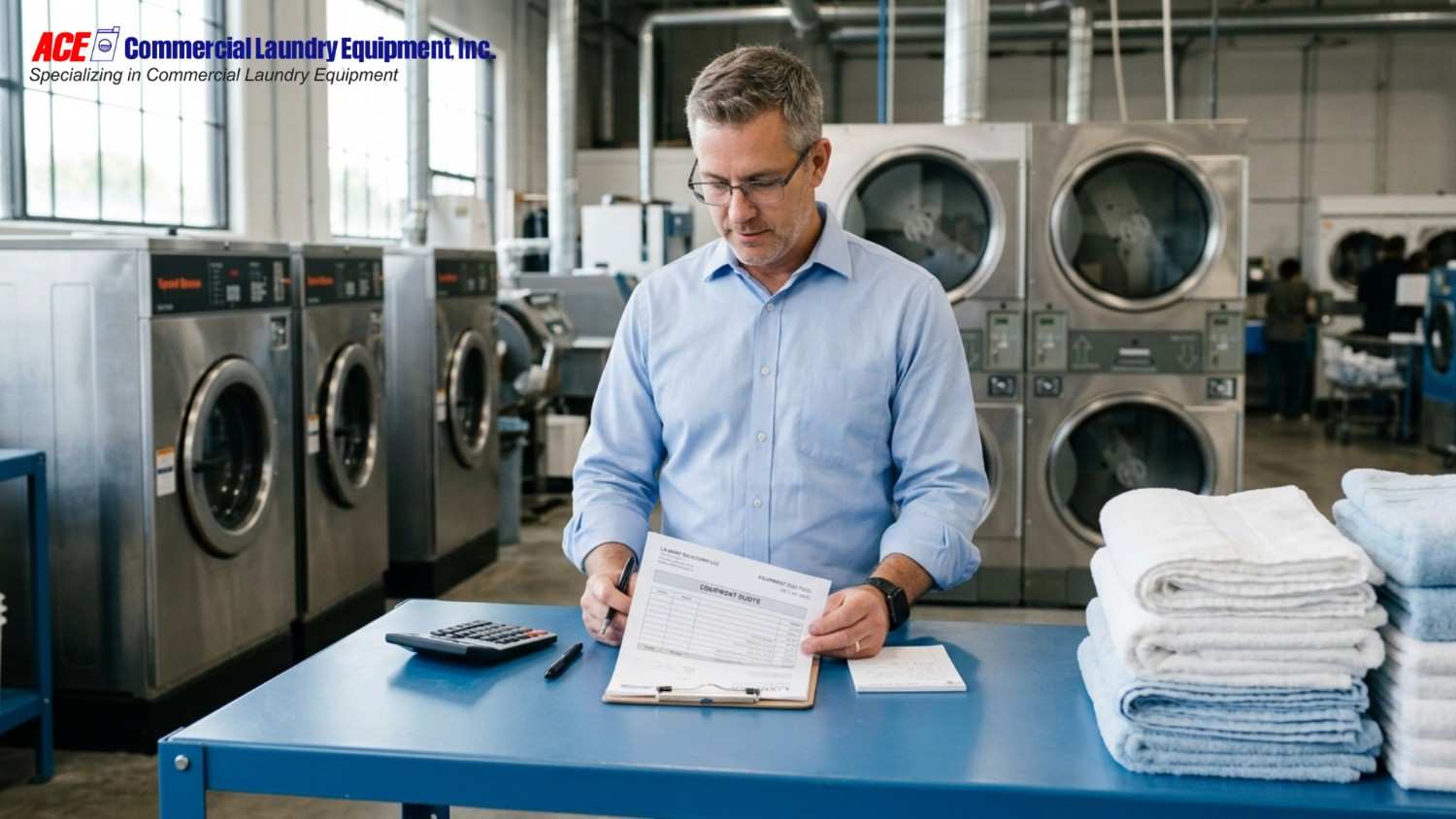
A strong commercial laundry equipment quote should show you more than the purchase price. Ask every vendor for a clear breakdown of equipment costs, installation, utility requirements, warranty coverage, service support, financing options, expected operating costs, and any fees that could affect your total investment.
When you compare quotes, do not stop at the lowest number. The right machines should help you control water, energy, labor, maintenance, and repair costs over time. A detailed quote gives you the facts you need to choose equipment that fits your operation, protects your budget, and performs reliably every day.
1. What Should a Commercial Laundry Equipment Quote Actually Include?
Bundled commercial laundry equipment pricing makes it hard to evaluate your options clearly. Before you review any quote, make sure you know exactly what the price includes. An itemized quote shows you the cost of each machine, each service, and each add-on. The best commercial laundry machines should justify their cost at every line of the quote, not just the final total.
Why Itemized Quotes Beat Flat-Fee Pricing
Flat-fee quotes often combine the machine price with required services, which makes the total hard to evaluate. That single number may look simple, but it does not show where your money is going. Ask every vendor to list separate pricing for each machine, installation labor, delivery, rigging, and any extra services. Without line items, you cannot identify which vendor charges more for the machine itself, the installation, the freight, or the support package.
Delivery, Rigging, and Installation: Confirm What’s Covered
“Turnkey” does not mean the same thing to every distributor. One vendor may include delivery, machine placement, connection, and testing. Another may quote equipment only and charge you separately for everything else.
Get written confirmation that your quote includes delivery to your facility, rigging into position, installation, and a final function test. Confirm that the commercial laundry machines match your building’s current setup. Hard-mount units require floor anchoring and a reinforced concrete foundation to absorb spin-cycle vibration. Soft-mount machines use internal suspension systems to manage that vibration without floor anchoring.
Freight as a Negotiable Line Item
For larger orders, ask to see the freight carrier’s actual invoice. Some distributors mark up shipping beyond the carrier’s real rate. Request pricing for the same brand and model from more than one vendor so you can establish a fair market baseline.
Treat freight as its own negotiable line item. Do not let a vendor bury it inside the unit price.
2. Which Specs Reveal Real Operating Costs?
Once you know what the quote includes, shift your focus to utility consumption. Operating costs accumulate every day after installation, and the spec sheet is where you find the data to project them accurately.
Ask for every figure in writing. Verbal estimates carry no weight when a utility bill arrives.
Capacity, G-Force, and Your Drying Costs
G-force measures how much water a washer extracts during the final spin cycle. A higher G-force rating removes more water before the load reaches the dryer, which can reduce drying time and lower utility costs per cycle.
Ask for the G-force rating on every washer in the quote. Then make sure the washer and dryer capacities match. A 60 lb washer paired with a 30 lb dryer creates a bottleneck that offsets much of the time and cost savings the washer delivers.
Utility Consumption: Request Manufacturer Spec Sheets
Request the manufacturer’s official spec sheet for every commercial laundry machine in the quote. These sheets show water use, electrical draw, and gas consumption in actual figures, not sales estimates.
Use those numbers to project your monthly utility costs. Two machines with similar purchase prices can have very different water, gas, and electricity requirements. At high daily volume, even small differences in per-load consumption add up significantly over a full year.
Programmability and Cycle Customization
Ask if the machines support customizable wash programs. Programmable cycles let you adjust wash intensity, water levels, and cycle settings based on the actual load.
That flexibility can reduce detergent use, protect fabrics, and help you avoid over-washing. Machines locked into a single default setting give you less control over cycle efficiency, chemical use, and fabric care.
ALSO READ: How to Buy Commercial Laundry Equipment and Compare Your Options
3. What Do Commercial Laundry Equipment Warranty Terms Actually Cover?
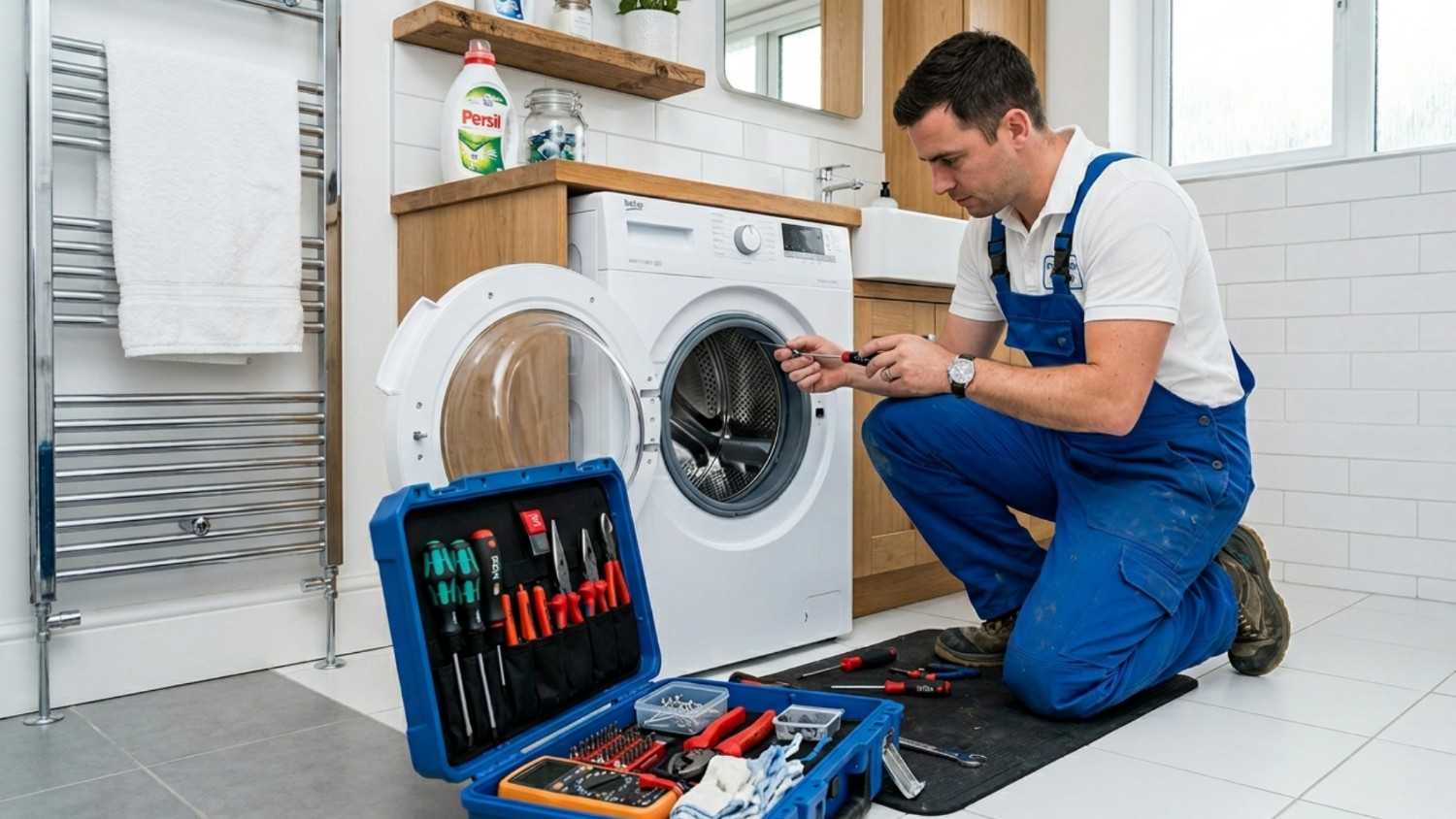
Unexpected repair costs are the most common source of budget overruns after installation. Warranty coverage determines how much of that risk the vendor absorbs and how much falls to you.
A five-year warranty means very little if it excludes the parts most likely to fail. Read the full warranty document before you commit, not after.
What a Warranty Actually Covers
Ask if the warranty covers parts, labor, and service calls, or only certain categories. Then review every exclusion.
Wear-and-tear parts such as bearings, door seals, and drive belts are often excluded, even in warranties described as comprehensive. If those parts fail later, you pay out of pocket regardless of the stated coverage period.
Post-Warranty Maintenance Costs and Standard Coverage Periods
This section addresses what your vendor is contractually obligated to provide while the warranty is active and what maintenance costs look like once that coverage ends. Section 4 covers how to evaluate a vendor’s actual service capability on an ongoing basis.
Warranties on commercial laundry equipment vary by brand, model, component, and product tier. Once that coverage expires, maintenance becomes a regular operating cost. Get post-warranty service agreement pricing before you buy. Confirm that the agreement specifies what inspections, preventive maintenance, and standard service calls are included. A planned inspection schedule helps you budget predictably rather than waiting for a breakdown to force an unplanned call.
Machine Lifespan and Its ROI Impact
Ask the vendor how long each commercial laundry machine should last under your expected usage. Build quality and brand standards affect longevity in ways that are not visible in a sales presentation.
A higher-priced machine that runs reliably for ten or more years may cost less over its full service life than a cheaper option requiring replacement in five. Calculate the total replacement cost, including reinstallation, before assuming the lower-priced quote saves you money. The best commercial laundry machines are not always the lowest-priced models. They are the machines that deliver reliable performance, manageable repair costs, and better long-term value for your workload.
RELATED ARTICLE: Leasing vs. Buying Commercial Laundry Equipment: How to Decide
4. How Fast Can a Vendor Respond?
Every machine will need service at some point. The real question is how quickly your provider can get you back up and running.
This section focuses on the vendor’s operational support capability: parts availability, response times, and ongoing service access beyond what a warranty document specifies.
Local Parts Inventory vs. Shipped-In Parts
Ask where the distributor stocks parts. A vendor with local inventory can often dispatch a technician with the right component the same day. A vendor ordering from a regional warehouse may add several days to your repair timeline.
Ask for average lead times on common wear parts for each model in the quote. That answer tells you how much downtime to plan for when a machine needs attention.
ACE Commercial Laundry Equipment Inc. stocks parts locally across Southern California, so technicians arrive with the components needed to complete repairs without waiting on warehouse shipments.
Response Times, Emergency Coverage, and Loaners
Get a clear answer on average response time for standard service calls. Ask if the distributor offers emergency or after-hours service.
For high-volume commercial laundry operations, downtime directly affects your ability to serve customers, residents, guests, or staff. Make sure any vendor you evaluate can provide a comparable commitment in writing.
Key questions to confirm before signing:
- What is your typical service response time?
- Do you offer after-hours or emergency service?
- Do you provide a loaner machine when a unit needs major repair?
LEARN MORE: Choosing Commercial Laundry Equipment for Your Business and Budget
5. How to Benchmark Your Equipment Quote?
You have reviewed what the quote includes, confirmed operating costs, assessed warranty terms, and evaluated service support. When comparing commercial laundry equipment for sale, the final step is making sure the payment terms fit your cash flow, and the total price is fair relative to the market.
Strong financial terms protect your budget and give you leverage if something goes wrong during delivery or installation.
Payment Schedule: What You Owe and When
Confirm if the vendor requires full payment upfront, at delivery, or after verified installation. Ask how much deposit they require and what milestone triggers the final payment.
Avoid paying in full before the machines are installed, tested, and confirmed operational. Paying the full balance before sign-off removes the leverage you need if installation runs into problems.
Leasing vs. Buying: Run the Numbers
Leasing can help you preserve capital and upgrade equipment on a defined schedule. Buying may make more sense when your expected usage supports a long equipment life and the financed cost stays lower than the total lease payments.
Compare lease rates and financed purchase terms over the same timeline. Then calculate your total cost at the three-year and five-year marks. A lower monthly payment does not always mean the better cash-flow decision over the full term.
How to Benchmark Fair Market Pricing
Request quotes for the same brand and model from multiple distributors. Even if you prefer to buy locally, outside pricing gives you a useful market reference.
Use those quotes to negotiate unit pricing, freight, installation, or service terms with your preferred vendor. When you compare commercial laundry equipment for sale across different brands, require vendors to justify any price premium with performance data, warranty terms, or documented service capabilities. Brand reputation alone is not enough.
Get a Quote Showing the Full Picture
Use your quote to confirm the details that affect real ownership cost: equipment, installation, utilities, warranty coverage, service access, and payment terms. If you want a line-item quote that clearly explains what is included, ACE Commercial Laundry Equipment Inc. can help you review your options with confidence.
As a Premier Huebsch® dealer with local parts stocked across Southern California, ACE Commercial Laundry Equipment Inc. can service your equipment without waiting on regional warehouse lead times.
ACE Commercial Laundry Equipment Inc. has supplied and supported commercial laundry operations across Southern California since the late 1950s. Contact the team at 14404 Hoover St, Westminster, CA 92683, or call 714-640-6674 to request an itemized quote for your operation.
Frequently Asked Questions
What is the difference between a hard-mount and soft-mount commercial washer?
A hard-mount washer bolts to a reinforced concrete floor and uses the building structure to absorb spin-cycle vibration. A soft-mount washer uses an internal suspension system to control vibration without floor anchoring. Your building structure usually determines the better choice. Hard-mount washers fit facilities with the right concrete foundation. Soft-mount washers work better for upper floors or buildings that cannot support hard-mount requirements.
How many machines does a facility typically need?
Your facility needs enough machines to handle peak daily volume without creating bottlenecks. Start by calculating your busiest day’s laundry volume in pounds, then compare that number against each machine’s capacity, cycle time, and your operating hours. A qualified distributor should model your actual workflow before recommending a machine count.
Should I buy new or reconditioned commercial laundry equipment?
New commercial laundry equipment usually offers strong long-term value for operations that need reliable daily performance. New machines include full manufacturer warranties, current efficiency ratings, and lower repair risk. Reconditioned equipment costs less upfront, but it often comes with limited warranty coverage and a higher chance of service issues.
What lead time should I expect between ordering and installation?
Lead time depends on the brand, model, order size, and current inventory. In-stock commercial laundry machines may ship faster than custom configurations or larger-capacity units, but timelines vary. Before you order, ask if the machines are in stock and have the vendor include expected delivery and installation dates in the quote.