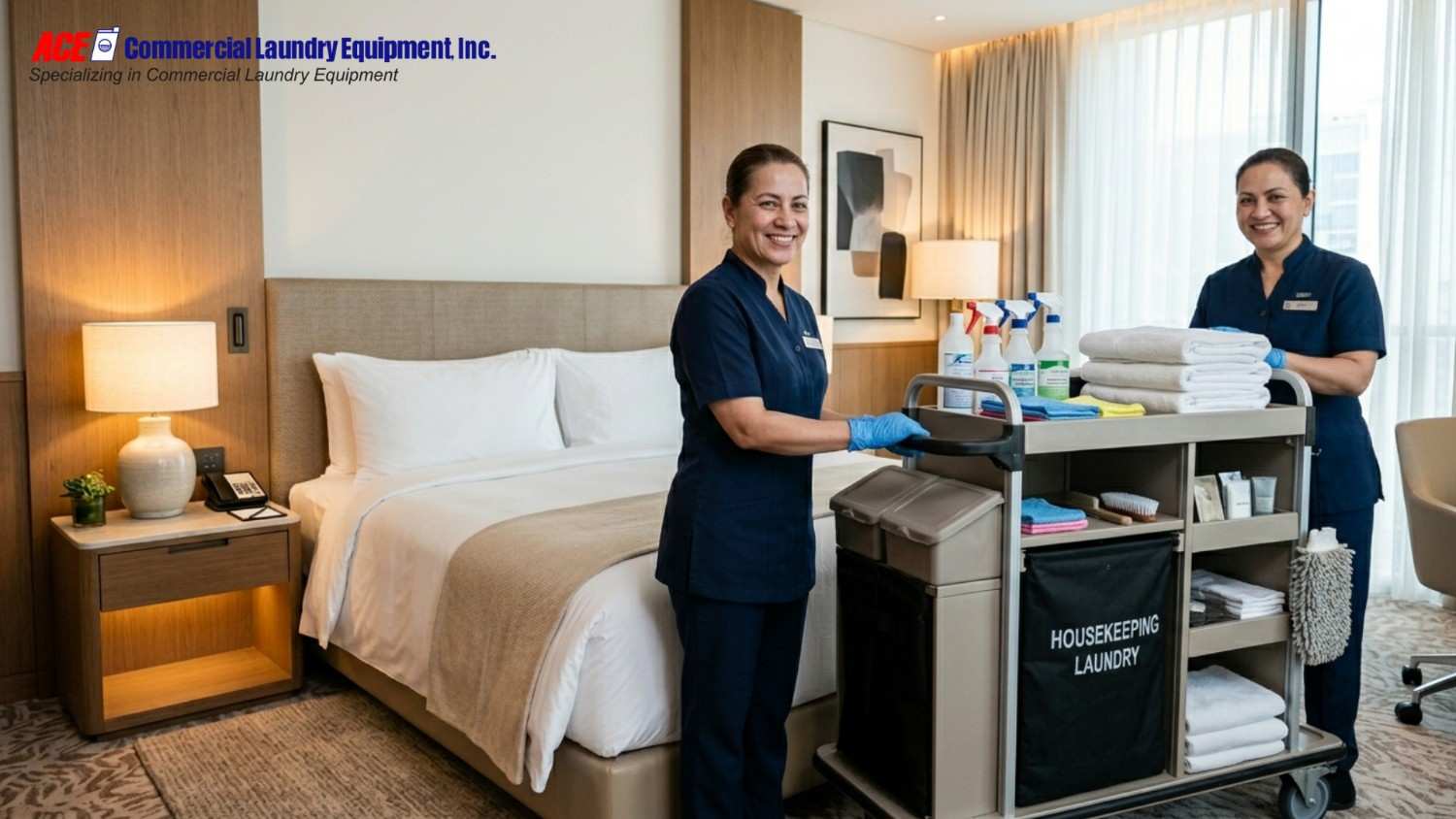
Your hotel laundry equipment can cut operating costs or quietly drain your budget. The difference comes down to your property’s math: demand, staffing, utility costs, and how efficiently your laundry room runs. When those numbers support in-house processing, on-site laundry can beat outsourcing on cost, control, and turnaround time. When they do not, you may pay fixed costs that an outside provider could handle for less. This blog shows you where that line is so you can make the right call for your hotel.
The Real Cost Question: Volume, Occupancy, and Labor
On-site laundry and outsourcing use opposite cost models. On-site laundry gives you a fixed-cost model. Outsourcing gives you a variable-cost model. The right choice comes down to your property’s size, occupancy, labor costs, and daily linen volume.
How Fixed Costs and Per-Pound Pricing Compare
In-house laundry comes with costs you pay every month, whether your hotel is sold out or half-empty. These include commercial hotel laundry equipment financing or depreciation, staff wages, utilities, chemicals, repairs, and maintenance. Your bill may stay roughly the same during both busy weeks and slow periods.
Outsourcing works differently. You pay a set price per pound, and that cost moves with your actual laundry volume. If your hotel has steady, heavy demand, your fixed costs spread across more loads, and your cost per pound drops. If your volume is light or unpredictable, outsourcing often costs less because you avoid paying for equipment and labor you do not fully use.
The Room-Count and Occupancy Threshold
The clearest signal is size. On-site laundry typically becomes cost-effective at around 100 to 150 rooms with occupancy holding at 65% or higher. That combination produces enough consistent volume to justify the fixed investment.
- Below 100 rooms: Equipment, labor, utilities, and maintenance often outweigh the savings, so outsourcing usually makes more financial sense.
- At 150+ rooms with high occupancy: Your laundry room has enough daily linen flow to keep equipment productive, which can lower your cost per pound below outsourced rates.
- A hidden factor: Some commercial laundry vendors do not serve smaller hotels under the 100- to 150-room range. Smaller properties in that gap may keep laundry equipment in hotel facilities because it is the most practical option, not because it is automatically the cheapest.
When On-Site Laundry Saves Money
On-site laundry starts to win when your volume, staffing, equipment, and space all work together. When your property meets these conditions, running laundry in-house can give you lower costs, faster turnaround, and more control.
High-Volume Operations and Economies of Scale
The savings become meaningful once your hotel processes roughly 500 pounds of laundry per day. At roughly 500 pounds per day, your washers and dryers can run closer to capacity instead of sitting idle between partial loads.
Consistency matters just as much as size. A hotel that runs heavy laundry volume seven days a week gets more value from every washer, dryer, and labor hour than a property that only fills machines on weekends. Commercial laundry machines for hotels perform best when they match steady daily demand, not occasional peak loads.
Equipment Efficiency That Lowers Utility Costs
Modern commercial washers and dryers can lower your utility costs when you choose and operate them correctly. High-G-force commercial washing machines for hotels remove more water during the spin cycle, which shortens drying time and reduces gas or electricity use. Moisture-sensing dryers stop once linens are dry, helping you avoid wasted energy and unnecessary fabric wear.
The biggest savings usually come from pairing high-extraction washers with efficient dryers. When your equipment matches your hotel’s actual volume, utilities become more predictable, and your laundry room runs with less waste. As an authorized Huebsch dealer, ACE Commercial Laundry Equipment Inc. supplies efficient, American-built machines, and the right commercial laundry equipment for hotel operations turns utilities from a runaway expense into a more controlled operating cost.
Quality Control and Faster Turnaround
Running laundry in-house gives you direct control over wash cycles, detergent choices, handling standards, and inspection. That control helps protect your linens and towels, reduce replacement costs, and maintain the level of cleanliness your guests expect.
Faster turnaround also matters. When your team can wash and return linens immediately, you can reduce your PAR levels, meaning the backup linen inventory you keep on hand. This is especially valuable for spas, resorts, luxury hotels, and high-occupancy properties where guests expect spotless textiles without delay.
Remote Locations
Distance can change the entire calculation. Many Southern California hotels sit outside the dense coverage area of large commercial laundry providers, where pickup fees, delivery costs, and transportation delays add up quickly. ACE Commercial Laundry Equipment Inc. serves these SoCal properties directly, and in that situation, on-site laundry may remove the logistics problem and give your housekeeping team the reliable supply it needs.
LEARN MORE: A Practical Guide to Choosing Commercial Laundry Equipment for Long-Term Growth
When Outsourcing Is the Cheaper Choice
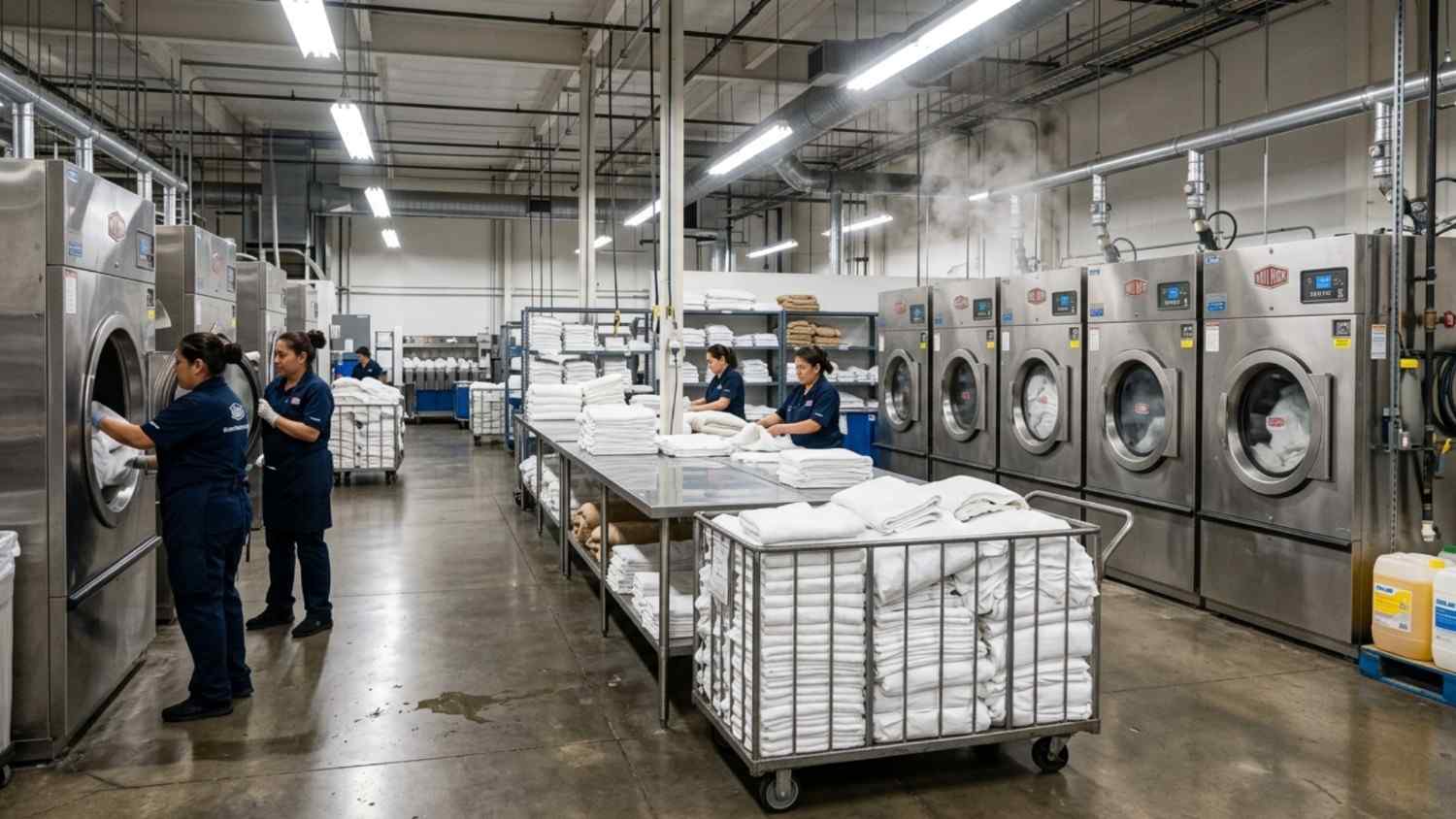
The same fixed costs that help high-volume hotels can hurt properties with lighter or uneven demand. If your hotel does not use its laundry equipment consistently, outsourcing may protect your budget and simplify operations.
Low or Fluctuating Occupancy
Seasonal resorts and boutique hotels often have busy peaks and slow stretches, which makes in-house laundry harder to justify. During slow months, your laundry room may run below capacity while staffing, service, and utility costs continue.
For seasonal hotels, outsourcing can protect your budget during slower months because the bill drops with linen volume. That can make budgeting easier, especially if your hotel deals with seasonal swings or unpredictable booking patterns.
Limited Space and Opportunity Cost
Hotel laundry room equipment, including commercial washers, dryers, ironers, folding tables, carts, and sorting areas, takes up valuable square footage. In a space-limited hotel, that laundry room may compete with guest rooms, meeting space, storage, or other revenue-producing areas.
Your on-site laundry is a cost center. If that same space could generate more revenue in another use, the opportunity cost may outweigh the savings you gain from processing laundry in-house.
Labor Burden and Linen Lifespan
Labor is one of the hardest laundry costs to control. When you run laundry in-house, you manage wages, benefits, training, scheduling, supervision, and turnover. If your property already struggles with staffing, the laundry room can become a constant operational pressure point.
Outsourcing shifts that burden to the vendor. A strong commercial laundry provider may also help extend linen life through consistent processes and professional handling. For hotels with labor shortages or limited management bandwidth, those savings can outweigh the benefits of owning the equipment.
ALSO READ: When to Outsource Commercial Laundry Room Management Instead of Self-Managing
How to Optimize On-Site Laundry If You Go In-House
Clearing the room count and occupancy threshold does not guarantee savings. Your on-site laundry only works financially when you manage it with discipline.
Run Full Loads on the Right Schedule
Underloading machines wastes labor, utilities, water, chemicals, and time. Full loads let you process more linen with the same basic operating cost, which lowers your cost per pound.
Scheduling also matters. When possible, run full loads during off-peak hours to reduce labor pressure and take advantage of lower electricity rates where time-of-use pricing applies.
Match Equipment to Actual Volume
Right-sizing laundry equipment for hotels is critical. If you buy too much capacity, you pay for machines you do not fully use. If you buy too little, laundry bottlenecks can slow housekeeping and hurt guest readiness on busy checkout days.
A qualified hotel laundry equipment supplier should size your system based on your room count, occupancy, linen type, PAR levels, and peak operating days. The goal is simple: your laundry room should handle your busiest mornings without sitting idle the rest of the week.
RELATED ARTICLE: Water-Saving Tips for Commercial Laundry Rooms
Plan a Laundry Room That Fits Your Property
The best choice depends on how your property actually runs day to day. ACE Commercial Laundry Equipment Inc helps Southern California hotels compare equipment costs against vendor invoices and plan a laundry room around real operating demand. If you are weighing hotel laundry equipment for sale, our team can help you model the numbers before you invest. Contact us at 14404 Hoover St, Westminster, CA 92683, or call 877-630-7278 to request a consultation today, and we will recommend the right setup for your operation.
Frequently Asked Questions
Is it cheaper for a hotel to do laundry in-house or outsource it?
In-house laundry is usually cheaper when your hotel has enough steady volume to keep equipment and labor fully used. Smaller, seasonal, or inconsistent properties often save by outsourcing because they pay only for the laundry they process.
How many rooms does a hotel need to justify on-site laundry?
Most hotels need about 100 to 150 rooms to justify on-site laundry. Below 100 rooms, fixed operating costs often erase the savings.
How much does commercial laundry equipment for hotels cost to run?
The cost to run commercial laundry equipment for hotels depends on utility rates, labor, machine efficiency, and daily volume. Efficient machines cost less to run because they reduce water use, drying time, and wasted energy.
What hotel laundry equipment do high-volume properties need?
High-volume hotels usually need washer-extractors, dryers, and finishing equipment sized to daily linen pounds and peak checkout demand. The right mix keeps your housekeeping team stocked during busy checkout periods.
Does on-site laundry actually improve linen quality?
Yes, if your team manages the process well. On-site laundry gives you tighter control over how linens are washed, handled, and inspected.
How do I choose hotel laundry equipment suppliers?
Choose hotel laundry equipment suppliers that size your equipment around your actual room count, occupancy, linen volume, and available space. Your supplier should also provide durable commercial machines, installation support, training, and ongoing service.