Outsourcing commercial laundry room management becomes the better choice when repair costs, rising utility bills, and the constant need for staff involvement start to outweigh the benefits of self-managing. Owning commercial laundry equipment can be the right move when usage is predictable, and your team has the capacity to maintain it. When running things on-site turns into a time-consuming burden, the decision deserves a second look. This blog walks operators through six clear signals that a managed service has become the smarter path, plus the conditions where keeping things in-house still pays off.
The Real Question Behind Self-Managing or Outsourcing
The real question is this: Does the time, space, labor, and capital you invest in your laundry workflow still represent your best use of those resources? As volume increases and compliance requirements grow tougher, the math behind running commercial laundry equipment in-house keeps shifting. The decision is less about what you are capable of managing and more about how you are allocating your resources.
Why the Decision Has Shifted in Recent Years
The cost of commercial laundry machines, water, and energy has steadily risen, narrowing the gap between owning equipment and paying for a managed service. Sanitation expectations have tightened across healthcare, hospitality, and food service. Operators now view laundry as a strategic investment rather than a back-of-house necessity, which changes how they think about space, labor, and capital tied up in commercial laundry equipment.
How to Read Your Own Operating Signals
To decide between an off-site solution and self-managing, watch for six pressure points: cost, hygiene, labor, volume, space, and capital. One pressure point on its own is manageable. When three or more start straining your business, the cost of running your own commercial laundry equipment has likely outgrown the cost of contracting the work out.
Cost and Resource Pressure Signals
Many operators underestimate the true monthly cost of running their commercial laundry machines. Detergent and labor are easy to track, but utilities, depreciation, repairs, and oversight time often go unmeasured and add up quickly. Once those hidden numbers exceed what a managed contract would cost, the equation flips.
Hidden Operating Costs That Erode Margin
Look for these signs that costs have crossed the line from manageable to inefficient:
- Frequent repairs: Repeated service calls on every commercial laundry machine point to commercial laundry equipment past its useful life. When service visits become a monthly pattern, cumulative spend can rival the cost of replacement units.
- Increasing utility bills: Older washers and dryers consume more water, gas, and electricity per cycle than current high-efficiency models. A unit that was cost-effective five years ago may now add hundreds per month in excess utility spend.
- Chemical and supply expenses: Detergent, softener, and sanitizer costs scale faster than expected at higher volumes. Overdosing is common when staff lack training on proper chemical ratios, wasting product, and shorten linen life.
- Management oversight: Hours spent supervising wash quality or troubleshooting issues represent real labor cost, often unbudgeted. When an operations lead spends five to ten hours per week on laundry logistics, that time carries a payroll cost and pulls focus from revenue-generating tasks.
Capital Demands That Outpace Returns
Replacing a full bank of washers and dryers requires significant upfront investment. Facility upgrades for new electrical, plumbing, or ventilation work add another layer of cost. Operators weighing this purchase outlay should compare it directly against a managed service contract, which can remove the capital burden entirely and roll installation, maintenance, and service into a single predictable agreement. Financing also exists for operators leaning toward owning commercial laundry equipment, which keeps both paths open while the numbers get sorted out.
ALSO READ: How Commercial Laundry Room Management Can Increase Property NOI
Hygiene and Compliance Risk Indicators
The cleanliness of your linens directly impacts sanitation, infection control, and brand standards in regulated industries. When wash quality fluctuates, the risk shifts past inconvenience into liability territory. Reliable results depend on properly matched commercial laundry equipment and the operational discipline behind it.
Inconsistent Cleaning Outcomes
Linens returning with stains, odors, or visible residue suggest your commercial laundry machine cycles are not delivering repeatable output. The wash quality that varies based on who loads the unit creates unpredictable results. Customer or patient complaints about linen quality are the loudest signal that change is needed. Equipment age, chemical dosing, and water temperature all factor in, and older commercial laundry equipment struggles to maintain uniform wash quality under heavy use.
Industry-Specific Compliance Gaps
Healthcare and hospital operators carry the heaviest documentation requirements around infection control. Hotels and resorts protect brand reputation with every linen touchpoint. Salons, spas, and gyms manage member perception with every towel. Third-party laundry providers typically run documented, repeatable processes that reduce the chance of compliance gaps slipping through, which is harder to deliver with aging in-house commercial laundry machines.
Labor and Management Strain
Every staff hour spent on laundry is an hour spent away from a higher-value job. The payroll cost is the obvious part. The opportunity cost is higher.
Staff Pulled From Higher-Value Work
Front-desk, clinical, and customer-facing staff covering laundry duties during peak hours represent misallocated labor. Managers who spend part of every shift overseeing wash quality lose focus on guest service, patient care, or member experience. A managed service returns those hours to the front line, freeing teams to focus on work that drives revenue rather than commercial laundry equipment maintenance.
Training Gaps and Turnover Cost
High staff turnover makes it difficult to maintain reliable wash procedures. New hires need frequent training on chemical handling and commercial laundry machine operation. Inconsistent training raises the risk of damaged linens and chemical errors, both of which carry real costs. A contracted laundry service delivers predictable wash quality regardless of who is on shift, an outcome that in-house programs rarely match at scale.
RELATED ARTICLE: How to Train Staff for Effective Laundry Room Operations
Volume and Scalability Concerns
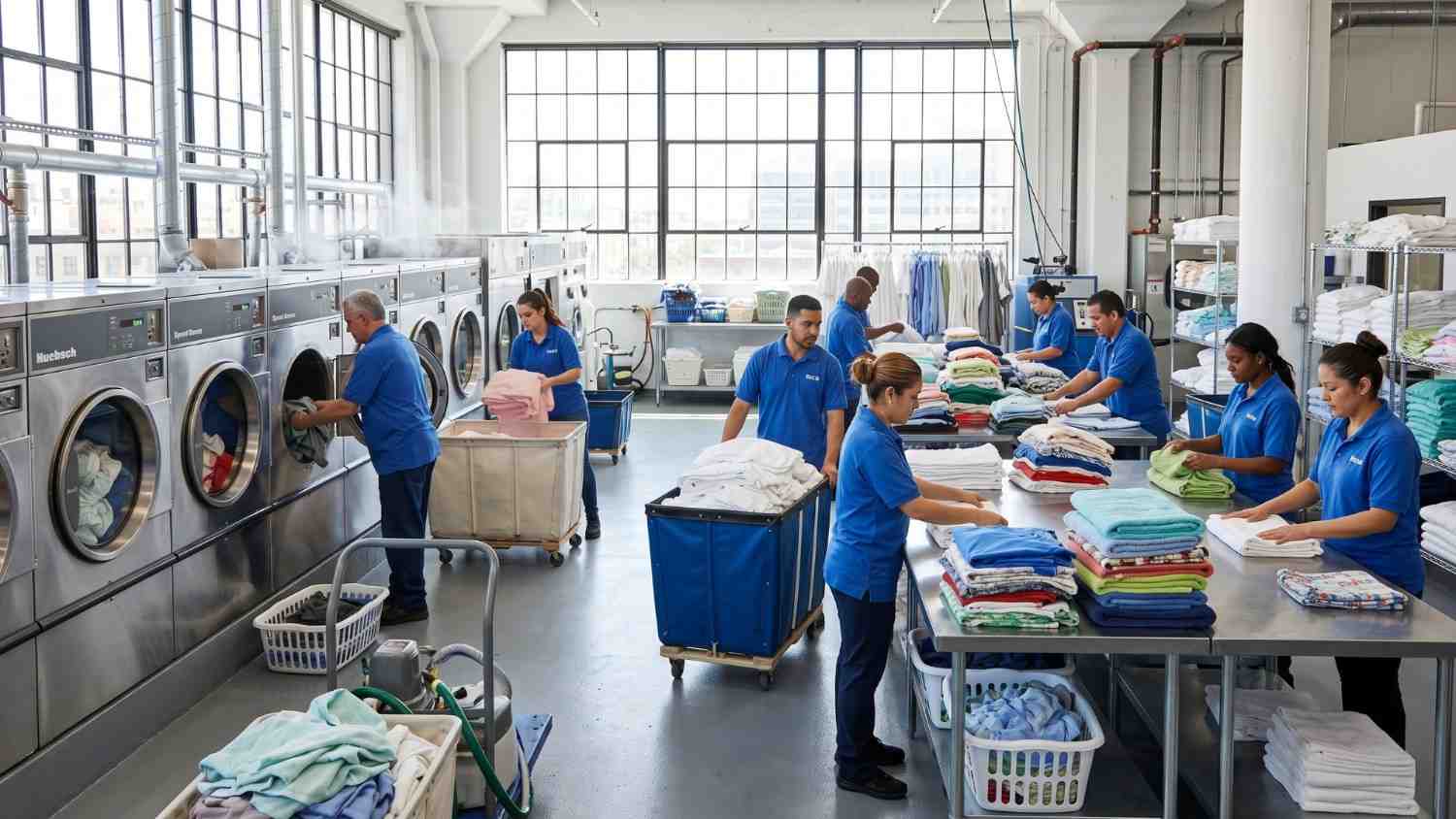
A managed commercial laundry service is the better fit when demand is unpredictable, seasonal, or growing faster than your equipment can absorb. Hotels, spas, gyms, restaurants, and healthcare facilities sit at the top of the candidate list since their linen loads fluctuate week to week.
Seasonal and Peak Demand Bottlenecks
Busy seasons create backlogs that current equipment cannot clear in a single shift. Occupancy spikes and special events overwhelm in-house capacity. Service quality drops at the exact moment guests, members, or patients judge your brand most critically.
Growth That Has Outrun Your Equipment
Machines running at maximum cycles every day leave no buffer for growth. Adding more commercial laundry machines requires capital, floor space, and infrastructure work that most operators want to avoid taking on twice. Off-site solutions offer scale without the buildout, which is one of the strongest reasons growing multi-housing operators consider managed laundry services rather than buying additional commercial laundry equipment.
Space and Facility Efficiency
Square footage tied up in a laundry room is square footage that cannot generate revenue or support better operations. Removing on-site commercial laundry equipment changes the floor plan calculation in measurable ways.
Square Footage Opportunity Cost
The laundry room may be occupying space that could become storage, additional units, staff facilities, or a revenue-producing area. Expansion plans that would require renovation or added floor space dedicated to laundry shift the cost calculation entirely. Operators who reclaim that footprint often redeploy it into space that produces direct returns or improves the guest, tenant, or member experience.
Workflow, Chemical Storage, and Safety Risk
Cramped layouts slow staff and raise injury risk. Chemical storage creates clutter, OSHA exposure, and ventilation concerns. Fewer washers, chemicals, and workflow dependencies on-site translate to fewer points of failure for facility managers responsible for safety and compliance.
The hidden cost of an unsafe layout also shows up in insurance premiums, workers’ compensation claims, and slow-response repairs when something goes wrong. Property managers who move to a managed laundry program shift those liability concerns to a partner who carries the appropriate coverage, trains technicians on safe chemical handling, and maintains the equipment to industry standards. The result is a cleaner facility profile, a leaner risk surface, and fewer late-night calls about leaks, spills, or breakdowns.
READ MORE: Managing Laundry Rooms in Apartment Buildings: Best Practices
When Self-Managing Still Makes Sense
A managed service is not the right answer for every operator. Some businesses see stronger results owning their machines, since their volume, turnaround needs, or specialty linen requirements demand on-premise control. For these operators, the focus shifts to selecting the right commercial laundry equipment for the workload.
High Consistent Volume With Dedicated Staff
Operators consistently processing over 500 lbs of laundry per week, with dedicated space and trained staff, often see stronger economics through ownership. Predictable, steady volume tilts the math back toward in-house operations. For this profile, investing in the best commercial laundry machines delivers long-term value, and our team helps buyers identify commercial laundry equipment for sale that matches their throughput targets.
Same-Day Turnaround Requirements
Some businesses, like high-turnover hotels, surgical facilities, and fitness centers, can’t afford the time delays of third-party pickup and delivery. Same-day turnaround calls for commercial laundry equipment under direct operational control. The best commercial laundry machines for these settings combine high capacity with programmable cycles that keep up with the workload at peak times.
Specialty Linen and Custom Wash Processes
High-value linens, delicate fabrics, and specialty wash protocols may require low-stress laundering not available through standard service contracts. Operators in this category usually benefit from premium on-premise commercial laundry equipment with advanced programmable controls. Reviewing the best commercial laundry machines for your linen mix matters more here than in any other use case, and matching specifications to your fabric profile protects your investment.
Find the Right Laundry Solution for Your Business
Deciding between outsourcing and self-managing your commercial laundry workflow comes down to where you want your resources to land. If your in-house program has become a burden, a managed agreement is worth pricing out. If you have steady volume and the right team, investing in commercial laundry equipment pays off over the long run.
At ACE Commercial Laundry Equipment Inc., we support operators on both sides of this decision. Operators ready to outsource get our laundry room management service, which covers installation, maintenance, and ongoing service under a managed agreement. You get reliable performance without the capital outlay or daily oversight.
For those who want to keep laundry in-house, we offer Huebsch commercial laundry machines for sale across Southern California. We help you select the right equipment based on your needs, with financing, parts, and service support included. Contact ACE Commercial Laundry Equipment Inc at 14404 Hoover St, Westminster, CA 92683, or call 877-630-7278 today for a site evaluation and find the best solution for your business.