A single washer-extractor failure can drain your clean linen supply within hours. In a hospital, that disruption does not stop at the laundry room. It can reach patient floors, delay surgical prep, strain staff, and create infection-control risks that may attract regulatory attention.
Too many facilities discover these gaps only after equipment goes down. Without a documented response plan, your commercial laundry equipment for hospitals can become a single point of failure. By then, your team has to react under pressure, and the costs can multiply fast.
This hospital laundry downtime checklist helps you prepare before an outage happens. You will know what to stock, what to inspect, and what to service to keep your laundry operation running with fewer interruptions. It covers emergency linen pars, containment supplies, equipment inspection tasks, infection-control protocols, testing steps, and service priorities for commercial laundry equipment for hospitals and supporting systems.
Why Every Hospital Needs a Formal Laundry Downtime Plan
Once linen output drops, your team needs more than a repair ticket. A formal downtime plan tells each department when to conserve linen, who contacts backup vendors, how staff handle soiled textiles, and when leadership escalates the response.
How Fast Does a Laundry Outage Impact Patient Flow
Your on-premise laundry (OPL) operation may run efficiently every day, but it often carries a thin margin of surplus linen. One failed washer-extractor or commercial dryer during peak processing can reduce output enough to delay bed turnovers, slow surgical suite restocking, and force staff to stretch available gowns, sheets, and towels.
ICU, ER, surgical, and isolation units usually feel the pressure first. These departments use more linen, require faster change-outs, and follow stricter handling protocols. The longer the outage lasts, the more your clinical teams compete for a shrinking supply.
Compliance Risks During a Linen-Supply Disruption
A linen shortage creates documentation pressure beyond the operational disruption itself. Your records need to show that staff followed established protocols for transport controls, escalation steps, and contamination prevention throughout the event.
A formal linen supply continuity plan helps your facility maintain structure during equipment failure. It gives your team the records it may need during internal reviews, accreditation surveys, or regulatory inspections.
Your plan should clearly document:
- When the outage was identified
- Which equipment or process was affected
- Who activated the downtime response
- When backup linen agreements were activated
- How your team tracked conservation measures and vendor activity
- When the equipment returned to service
Without that structure, your staff may improvise under pressure. That creates avoidable safety, documentation, and communication gaps.
Who Leads the Response
Laundry downtime affects several departments at once. Facilities handles the equipment issue. Infection prevention sets handling expectations. Supply chain activates backup linen agreements. Clinical leadership communicates changes to patient-care teams.
Name the downtime coordinator in the written plan, not during the outage. This person activates the checklist, manages the communication chain, and serves as the main point of contact for internal teams and outside partners.
Include role-specific instructions so each team knows what to do:
- Nurses: Linen conservation rules, bed-change criteria, and supply request procedures.
- Housekeeping: Recovery round assignments, linen handling reminders, and holding-area responsibilities.
- Materials management: Backup agreement activation, delivery tracking, and disposable supply distribution.
- Facilities: Equipment status updates, repair timelines, and service escalation.
- Infection prevention: Handling expectations, compliance documentation, and workflow review.
Your emergency contact list should include your laundry equipment for hospitals service partner, especially if they provide after-hours support, parts access, or temporary workflow guidance.
What to Stock Before Downtime Hits
The best time to build your emergency inventory is before your machines go offline. The right supplies give your team enough runway to repair equipment, activate backup vendors, or move to temporary workflows without disrupting patient care.
1. Emergency Linen Par Levels
Set a 48-to-72-hour emergency buffer for critical textiles. Calculate those levels by unit type, not by facility-wide averages. Your ER, ICU, and surgical suites use linen much faster than general medical floors, so their emergency pars should reflect actual usage.
Must-have items at emergency par levels:
- Bed sheets, pillowcases, and draw sheets
- Isolation gowns and surgical drapes
- Scrub suits and patient gowns
- Bath towels and washcloths
Temporarily reduce these items during downtime:
- Decorative duvets and accent linens
- Extra pillow covers beyond patient-use standards
- Non-clinical towels and staff amenity items
Build your buffer around your backup vendor’s turnaround time. If your outside laundry partner needs 24 hours from pickup to delivery, your emergency partners must cover that gap plus the time your team needs to identify, escalate, and manage the outage.
2. Containment, Handling, and Cleaning Supplies
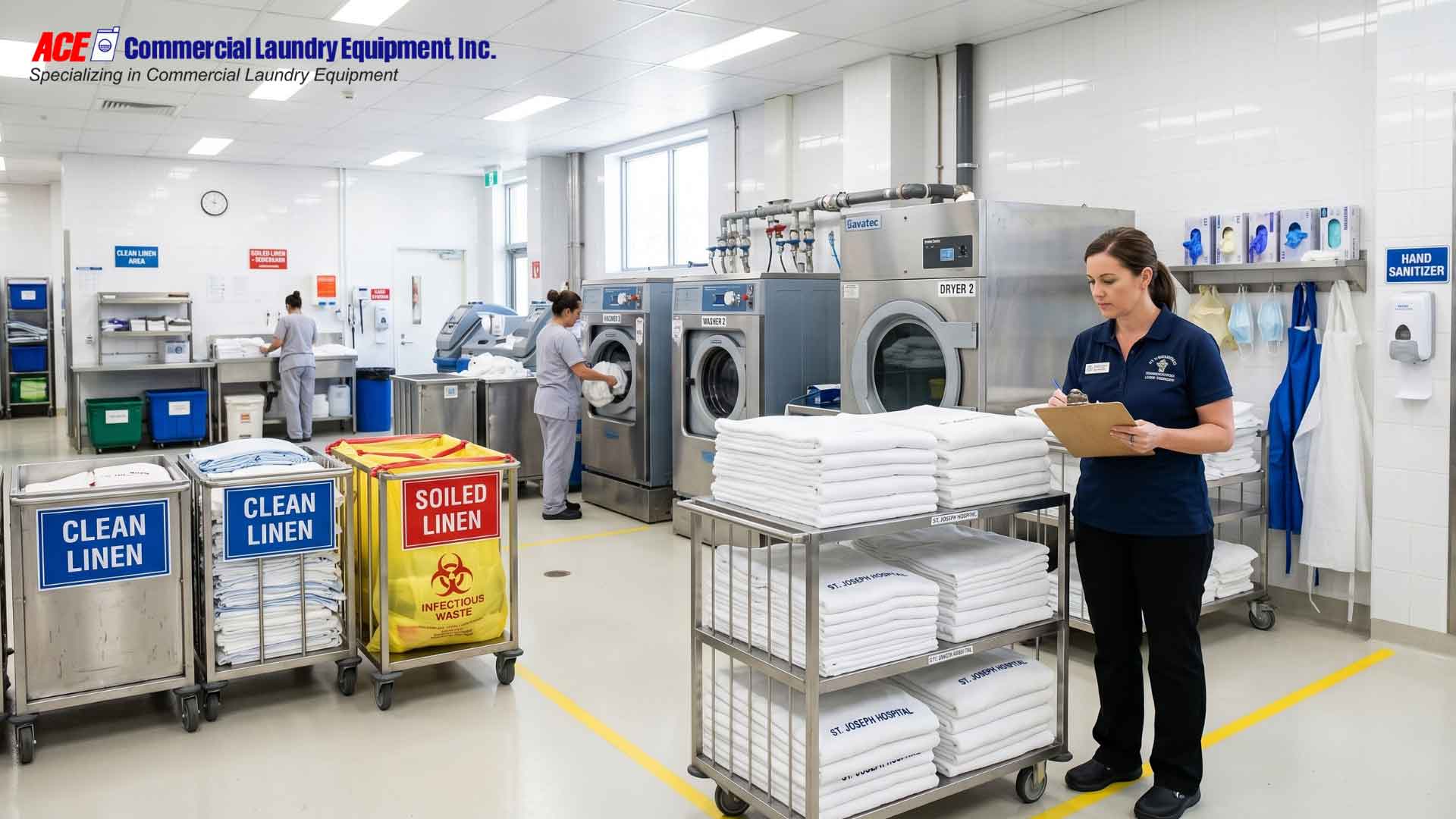
During downtime, your staff may need to handle, hold, or transport soiled linen manually. Store these supplies near soiled utility rooms, loading areas, and any approved overflow holding points so your team can respond quickly and safely.
- Linen containment: Use leak-resistant, water-soluble bags rated for contaminated textiles. Add heavy-duty, color-coded liners to help staff separate clean and soiled items without confusion.
- PPE for manual sorting: Keep tear-resistant gloves, waterproof gowns or aprons, and face protection available for staff who handle wet, soiled, or contaminated textiles.
- Labeling and tracking: Use pre-printed tags or tape to identify linen status during non-standard workflows. Clear labeling reduces mistakes when your normal process changes.
- Cleaning and sanitizing agents: Maintain a dedicated stock of institutional-grade commercial detergents, enzymatic stain removers for heavily soiled linens, and EPA-approved germicidal products for disinfecting carts, folding surfaces, laundry room contact points, and temporary holding areas during an outage. Keep these separate from your daily operational supply.
3. Backup Linen Sources and Vendor Contracts
Pre-negotiate backup linen terms before you need them, not during an active shortage. Set up linen-rental agreements or spare-capacity contracts with regional commercial laundry services when you still have leverage.
Your call tree should identify:
- Primary and secondary backup vendors
- Estimated pickup and delivery timelines
- Minimum order requirements
- Emergency contacts and after-hours procedures
- Delivery locations and loading dock instructions
List your hospital laundry equipment suppliers separately from your linen vendors, so your team can escalate repairs, confirm parts availability, and request temporary workflow guidance when needed.
5. Single-Use and Disposable Alternatives
Stock a limited supply of facility-approved disposable gowns, procedure towels, and bed-protection pads. These products give your team a short-term bridge while your permanent linen supply chain recovers.
Disposables should not become your main downtime strategy. Over-reliance drives up per-unit costs quickly, generates significant waste volume that your housekeeping and environmental services teams must manage, and often reduces patient comfort compared to reusable textiles. They work best as a controlled backup that fills a specific gap: protecting clinical operations during the hours or days it takes to restore your primary linen supply.
What to Service: Machinery and Infrastructure Readiness
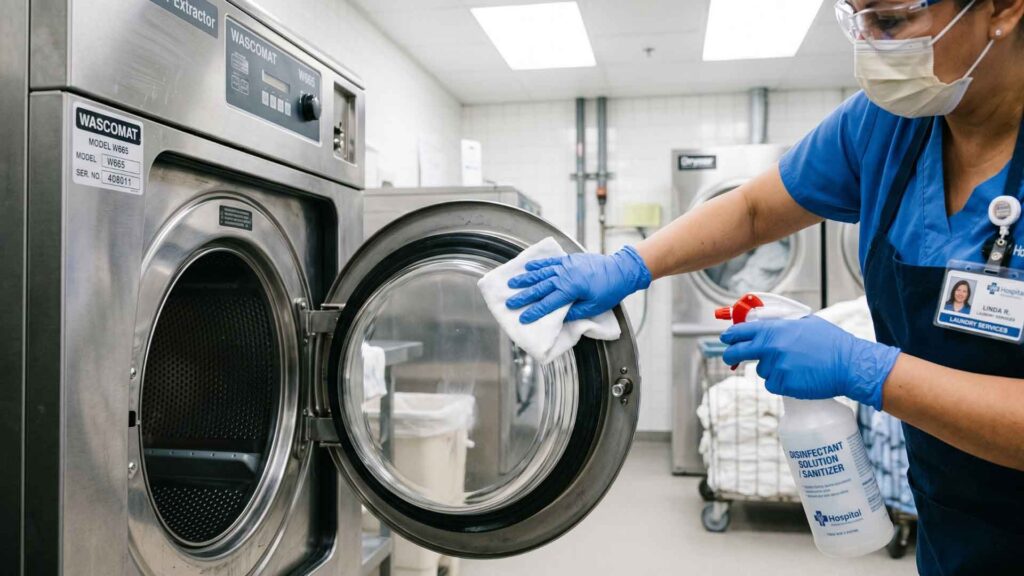
Routine maintenance helps prevent the sudden breakdowns that trigger your downtime plan. Your hospital laundry equipment preventative maintenance program should follow manufacturer recommendations and match the demands of a 24/7 healthcare environment. This includes your washer-extractors, commercial dryers, chemical systems, water systems, exhaust systems, and related infrastructure for laundry equipment in hospitals.
Daily and Weekly Service Tasks
Daily checks for all washers and dryers:
- Clear lint screens and traps completely
- Inspect rubber door gaskets and seals for debris, mold, or visible wear
- Check water-inlet filter screens for sediment
- Test emergency-stop buttons on every machine
- Wipe down detergent dispensers to prevent residue buildup
Weekly inspections:
- Inspect dryer ducts and internal vents for lint buildup or airflow restrictions
- Check belt tension on dryer drums
- Clean drum interiors to remove residue and fabric debris
- Verify chemical-dosing system accuracy
- Confirm injector pump operation and chemical concentration levels
- Test water temperature sensors and cycle timers
These tasks may seem routine, but they protect the equipment your hospital depends on every shift.
Monthly Deep-Service Priorities
Monthly service should focus on calibration, safety systems, and components that wear down under continuous use.
- Water-temperature calibration: Verify that wash cycles meet your facility’s validated disinfection parameters and approved wash formulas.
- Chemical-dispensing system verification: Confirm that detergent and sanitizer dosing match manufacturer specifications.
- Safety controls testing: Test door-lock mechanisms, automatic shutoffs, and fire-suppression systems to confirm proper operation.
- Bearing lubrication and motor inspection: Address friction, overheating, vibration, and early signs of mechanical wear before they cause a larger failure.
- Water supply and drainage inspection: Check incoming water quality, water softener operation, and drain line condition. Hard water buildup, inconsistent water pressure, or partial drain clogs can degrade wash performance and accelerate component wear across your machines.
This is where hospital laundry equipment preventative maintenance proves its value. Preventative service catches issues at the calibration or wear stage. Break-fix repair catches them after a machine stops mid-cycle during your busiest shift.
Quarterly and Annual Professional Service Triggers
Some inspections require specialized tools, diagnostics, and training. Schedule certified technicians for quarterly system reviews and a comprehensive annual inspection.
Quarterly professional service should include:
- Full airflow analysis for dryer exhaust systems
- Steam trap inspection and replacement as needed
- Control-board diagnostics and firmware verification
- Hose and fitting integrity checks with pressure testing
Annual service adds:
- Complete electrical system review, including dedicated circuit capacity and backup power priority for laundry operations
- Full bearing replacement assessment
- Equipment-life projection and repair-versus-replacement recommendations
- Capital planning support
Document every service event. Strong maintenance records support compliance readiness, simplify budgeting, and help your leadership team decide when to repair or fully replace aging laundry equipment in hospitals.
ALSO READ: When It Makes Sense to Repair or Replace Commercial Laundry Equipment
Infection-Control Protocols During Active Downtime
When your machines go offline, infection-control standards still apply. Your staff needs clear, practical instructions for handling linen, adjusting patient-care workflows, and documenting actions throughout the event.
Linen Conservation and Patient-Care Adjustments
Activate an “emergency bed-change only” policy when linen supply reaches your defined threshold. This limits linen changes to clinical need instead of routine schedules.
Pair that policy with “soiled-for-reason” documentation so staff records why each linen change occurred. This keeps conservation efforts clear, consistent, and auditable.
You can also assign housekeeping supervisors to conduct linen-recovery rounds in closed units, low-census floors, and post-discharge rooms. Redirecting unused inventory can extend your active supply without compromising patient care.
Soiled Linen Handling and Transport Safeguards
Your team should follow safe handling practices during every downtime event. Reinforce these expectations with visible reminders at handling points.
Your instructions should include:
- Contain soiled linen at the point of use
- Avoid open transport through patient corridors
- Do not shake contaminated textiles
- Sort only in designated staging areas
- Follow the PPE and containment protocols outlined in your stocking plan for all staff handling soiled or wet linen
- Maintain hand hygiene after every linen contact
Temporary holding areas should follow the same standards as permanent areas. If your facility uses a dedicated soiled linen zone, confirm that airflow and access controls help prevent cross-contamination into clean spaces.
Post quick-reference cards at nursing stations, linen closets, soiled utility rooms, and staff work areas. Infection control during laundry downtime depends on every shift being able to find and follow these steps without searching for the full policy document.
RELATED ARTICLE: Safety Tips for Handling Commercial Laundry Equipment
How to Build and Test Your Hospital Laundry Downtime Checklist
A checklist that sits untouched in a binder will not help your team during a real outage. You need to build it, test it, revise it, and keep it easy to access.
Assembling a Cross-Functional Planning Team
Your hospital laundry downtime checklist should include input from every department that touches linen supply, patient care, or infection control.
Bring these teams into the planning process:
- Facilities and engineering: Equipment status and repair timelines
- Infection prevention: Handling standards and compliance documentation
- Supply chain and materials management: Vendor contracts and par level monitoring
- Clinical leadership and nursing: Patient-care impact and floor communication
- External equipment service partner: Equipment diagnostics, parts availability, and temporary solutions
Each group sees a different risk. Together, they help you build a plan that works beyond the laundry room.
Running Tabletop Drills and Mock-Outage Scenarios
Schedule quarterly laundry outage drills. Walk through the full response sequence the moment a simulated equipment failure begins.
Your drill should test:
- Outage detection
- Downtime coordinator activation
- Vendor notification
- Linen conservation procedures
- Staff communication
- Soiled linen holding procedures
- Disposable supply distribution
- Equipment repair escalation
Document every gap the drill exposes. If your vendor response is too slow, renegotiate the agreement. If your par levels cannot support a 48-hour outage, increase your emergency buffer. If staff do not understand the escalation path, simplify it.
Each drill should lead to at least one concrete improvement.
Keeping the Checklist Accessible and Current
Store your checklist where staff can actually find it. Add it to your policy portal, intranet, shared resource center, and emergency preparedness materials.
A downloadable PDF is useful, but it should not be the only format available. If staff cannot remember the file path during a crisis, the checklist is not accessible enough.
Review your checklist at least twice per year. Update:
- Vendor contact information
- Emergency linen par levels
- Equipment inventory
- Service partner details
- Internal escalation contacts
- Disposable supply levels
- Communication templates
Assign one owner to keep the plan current. Tie the review cycle to your facility’s broader emergency preparedness calendar so it does not get overlooked.
Get Your Hospital Laundry Downtime Plan in Place
Your hospital laundry downtime checklist should give your team a clear path through every phase of an outage, starting at detection and ending at full recovery. Review your linen pars, service schedule, vendor contacts, infection-control steps, and communication plan on a regular cycle so your facility can respond quickly when equipment fails.
ACE Commercial Laundry Equipment Inc helps hospitals across Southern California with commercial hospital laundry equipment, preventative maintenance programs, and regional service with after-hours response. As a trusted hospital laundry equipment supplier, we provide the parts availability and technical support that keep your operation running. Contact our team at 14404 Hoover St, Westminster, CA 92683, or call 877-630-7278 to discuss your facility’s downtime readiness plan or request service for your current equipment.
Frequently Asked Questions About Hospital Laundry Downtime
How many days of emergency linen should a hospital keep on hand?
Most facilities should maintain a 48-to-72-hour buffer of critical textiles, calculated by unit type. High-consumption departments like the ICU, ER, and surgical suites need higher pars than general medical floors.
Who should lead the hospital laundry downtime response?
Assign a downtime coordinator in your written plan before an outage occurs. This person manages the communication chain and coordinates between facilities, infection prevention, supply chain, clinical leadership, and your external equipment service partner.
How often should we run a laundry downtime drill?
Quarterly tabletop drills give your team enough frequency to catch gaps in vendor response times, par level adequacy, and staff communication without disrupting daily operations.
What triggers the shift to disposable linens during an outage?
Your plan should define a specific par level threshold. When your active reusable linen supply drops below that threshold, your materials management team distributes disposable gowns, procedure towels, and bed-protection pads as a controlled backup.
Should laundry equipment be on backup power during a facility-wide outage?
Your emergency preparedness plan should address the power priority for laundry operations. If your laundry room is not connected to backup generators, a facility-wide electrical event becomes a laundry downtime event at the same time, compounding the impact on patient care.