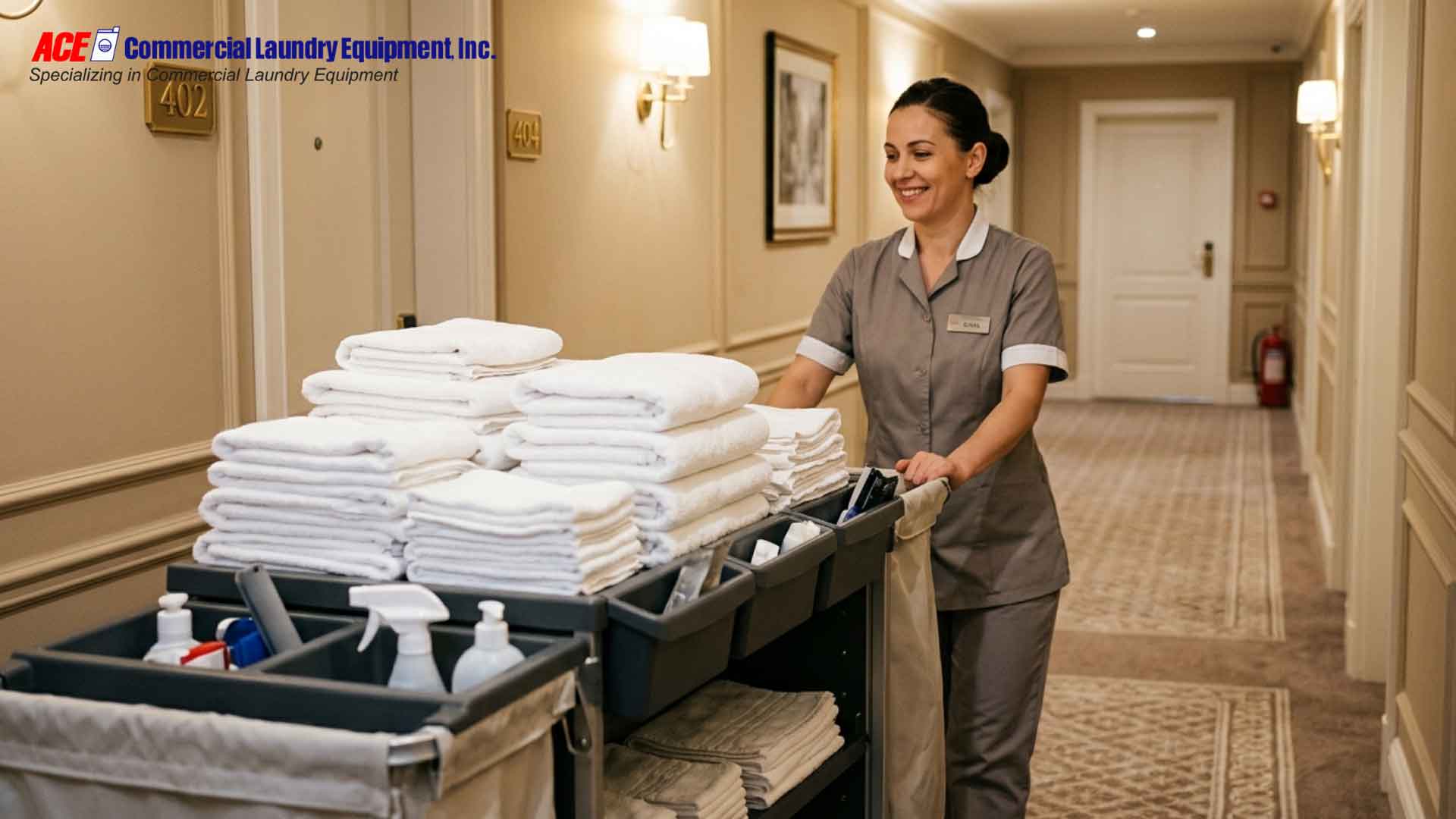
Hotels lose linen because small breakdowns happen every day: towels leave rooms, sheets get misplaced, staff miss sorting steps, and worn-out machines damage fabric before the linen reaches its expected lifespan. These issues add up fast, often costing your property thousands in annual replacement expenses. The fix starts with tighter laundry controls, better staff processes, and reliable hotel laundry equipment that protects linen, reduces waste, and helps you keep more of your inventory where it belongs.
The Real Cost of Linen Loss
Inventory shrinkage usually starts with small daily breakdowns across housekeeping, guest use, storage, and laundry. In most hotels, linens do not disappear all at once. They vanish through daily habits, missed procedures, guest behavior, and laundry mistakes that slowly drain your inventory and operating budget.
Where Linen Loss Happens
Replacement costs build through everyday operations. Guests may pack towels, robes, or bath mats as souvenirs. Housekeeping teams may accidentally throw soiled linens away when they get mixed with room trash. Staff may also use towels or washcloths to wipe spills, clean equipment, or absorb chemicals when proper rags are not available, which can ruin high-cost items instantly.
Your laundry room can also become a major source of damage. Overloaded washers, too much bleach, poor chemical balance, and excessive dryer heat weaken fabric and shorten linen life. A sheet or towel that should last through many wash cycles can wear out much faster when your process damages the fibers. Linen hoarding creates another problem: when staff stores extra inventory on different floors, managers may think items are missing and order replacements you do not actually need.
Four Root Causes of Inventory Shrinkage
- Guest Theft: Some guests take towels, robes, hand towels, and bath mats as souvenirs or as “included” perks. In high-occupancy properties, those missing items can become a steady replacement expense.
- Staff Misuse: When your team does not have enough cleaning rags or disposable wipes, they may use bath towels and washcloths for spills, chemicals, or equipment cleaning. Once contaminated, those linens often cannot return to guest use.
- Laundry Mix-ups: If you send linens off-property, every transfer creates risk. Items can get misplaced during pickup, delivery, sorting, or cross-property processing. Untracked discards make the problem worse because you lose inventory without a clear record of what happened.
- Wear and Tear: Harsh wash cycles, over-drying, chemical imbalance, and poor equipment maintenance break down fabric faster. When your laundry process runs correctly, you reduce avoidable fiber damage. When it does not, you replace items long before you should.
RELATED ARTICLE: Choosing Commercial Laundry Equipment for Your Business and Budget
Why These Losses Hit Your Bottom Line
The financial impact starts with more than the price of a towel or sheet. Inventory shrinkage does not just create a counting problem. It cuts into your profit, increases labor, raises utility costs, and pulls money away from maintenance, upgrades, and guest experience improvements.
The Hidden Math Behind Missing Inventory
A 300-room hotel typically keeps 3 to 4 par levels of linen per room. Even a small percentage of annual loss can force you to replace dozens of sets each year. The purchase price is only the first cost. Your team also spends time counting, ordering, receiving, sorting, laundering, and restocking replacements. When you add those labor and processing costs, replacement expenses become much more significant than they look on paper.
Why Replacement Costs Spiral
Replacement budgets rise when managers respond to shortages without clear inventory data. Your team may order more linens to cover what appears to be missing, only to find extra stock later in closets, carts, or floor storage. This creates bloated inventory and hides the real cause of the shortage. Rewashing stained or poorly processed linens adds more labor, water, energy, and chemical costs. Each extra cycle stresses the fabric and pushes your property closer to another purchasing order.
Five Strategic Solutions to Cut Linen Loss
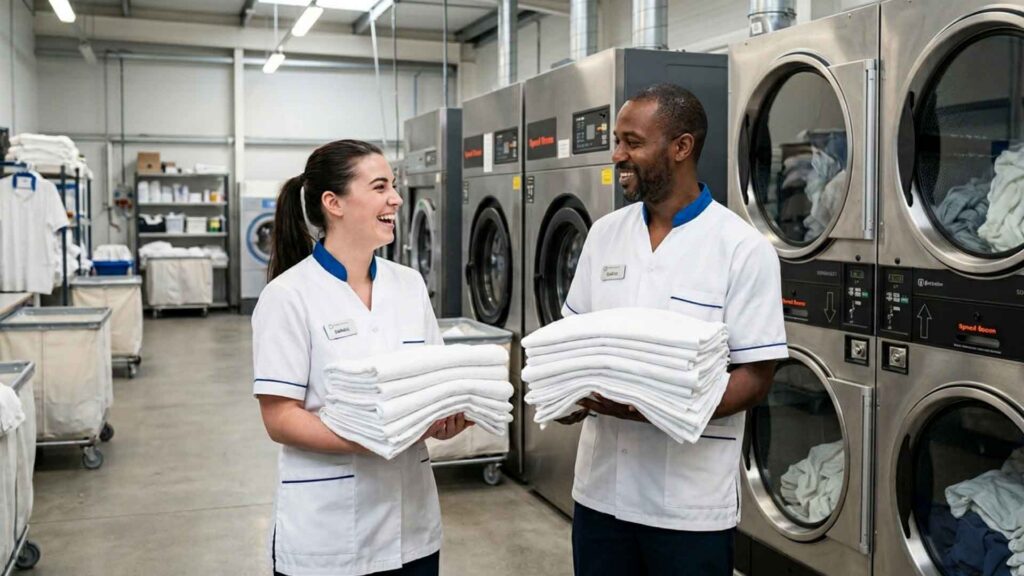
Inventory shrinkage is expensive, but you can control it with the right systems, equipment, and staff habits. These five strategies help your property reduce missing inventory, extend linen life, and protect your linen spend. Most hotels see the strongest results when they combine tracking, training, tighter laundry controls, and better equipment decisions.
Solution 1: Implement RFID Tracking Systems
Radio Frequency Identification (RFID) tracking helps you see exactly where your linens go. By tagging sheets, towels, robes, and other high-use items, your team can monitor inventory in real time instead of relying on manual counts. This visibility gives managers a reliable inventory trail and prevents hoarding across floors.
When managers know which items move through each department, they can spot patterns faster. If towels disappear from one floor or robes fail to return from specific rooms, your team can act before the loss becomes a larger expense. RFID requires an upfront investment, but it can quickly pay for itself through better inventory control and fewer unnecessary replacement orders.
Solution 2: Upgrade to On-Premise Laundry Equipment
Bringing laundry operations in-house gives your property more control over linen handling, wash quality, and inventory movement. With on-premise hotel laundry equipment, your team keeps linens on-site, controls each wash cycle, and reduces the handoff points where items often go missing.
The right commercial washing machines for hotels also improve consistency during every cycle. Huebsch commercial laundry machines for hotels feature programmable wash settings, moisture sensors, and chemical controls that help standardize each cycle without guesswork. When your hotel laundry room equipment follows consistent wash protocols, you reduce rewash rates, prevent over-drying, and improve fabric care.
For Southern California hospitality properties, ACE Commercial Laundry Equipment Inc. offers Huebsch on-premise solutions with a critical advantage: local service response within 4 hours. When equipment needs attention, you’re not waiting days for a regional technician. ACE Commercial Laundry Equipment Inc.’s local presence means faster turnaround, less downtime, and more reliable linen availability for your operation. For many properties, the combined savings from lower replacement costs, improved turnaround, reduced outside laundry fees, and the security of fast local service justify the investment within 18-24 months.
Solution 3: Deploy Targeted Staff Training
Your staff plays a major role in linen protection. Clear training helps your team understand what should go to the laundry, what should be discarded, and what should never be used as a rag. Without that guidance, towels and washcloths often end up cleaning spills, chemicals, equipment, or back-of-house messes.
Give your housekeeping and laundry teams simple, visible systems. Use color-coded bins or bags for salvageable linens, damaged items, and cleaning cloths. Train staff to check linens for sharp objects, avoid unnecessary towel changes, and report damaged inventory instead of hiding it. When your team follows the same process every day, you reduce waste and build accountability across the property.
Solution 4: Optimize Par Levels and Usage Tracking
Your par levels should reflect how your property actually uses linen, not outdated assumptions. Most hotels keep three to four par levels per room, but your pool, spa, banquet, and housekeeping departments may need different inventory levels based on turnover and guest volume.
Track linen usage by department so you can see which areas drive the most loss. If your pool towels disappear faster than room towels, your prevention plan should focus there first. If one floor constantly runs short, check for storage habits, cart-loading issues, or missed returns. Department-level tracking helps you buy only what you need and direct your attention where it matters most.
Solution 5: Reduce Rewash Rates Through Proper Cycles
Every rewash costs your property time, labor, water, energy, chemicals, and fabric life. When linens come out stained, poorly rinsed, or over-processed, your team has to run them again, which weakens fibers and shortens their useful life.
Start by checking your wash formulas, detergent dosing, water temperature, rinse times, and machine performance. Use harsh chemicals and reclaim cycles only when linens truly need them. Proper calibration helps your team remove soil the first time, which cuts repeat cycles and reduces unnecessary fiber stress. Well-maintained commercial hotel laundry equipment can make this process more consistent across every load, especially when your team relies on laundry equipment in hotel operations every day.
ALSO READ: When On-Site Hotel Laundry Saves Money and When It Does Not
Calculating Your Potential Savings
Before you invest in new systems or equipment, calculate what worn linens and replacement costs already drain from your operation. A clear cost model helps you see the financial opportunity in reducing loss, improving turnaround, and optimizing your laundry process.
Quick Cost Model
Start with your actual numbers:
- 300-room hotel × 3.5 par levels per room = 1,050 total linen sets in circulation
- Average cost per set (sheets, towels, washcloths) = $15
- Current annual loss rate = 15%
- Annual replacement sets needed = 1,050 × 0.15 = 157 sets
- Current annual replacement cost = 157 sets × $15 = $2,355
Now add secondary costs: labor for ordering, receiving, sorting, and restocking (estimate 40 hours/year × $18/hour = $720). Plus extra utility and chemical costs from rewashing (estimate $400/year). Total annual cost of missing inventory and wear = approximately $3,475.
If you reduce loss by 40-50% through RFID, training, and better equipment:
- New loss rate = 9% (down from 15%)
- New replacement sets = 94 sets/year × $15 = $1,410
- Reduced rewash labor and utilities = ~$500 in savings
- Potential annual savings = $1,565 (roughly 45% reduction in total linen-related costs)
Expected Payback Timeline
Hotels that invest in hotel commercial laundry equipment typically recover the cost through lower replacement expenses, fewer rewashes, reduced outsourced laundry fees, and improved linen control. Once your property reaches breakeven, the savings continue because your loss rate stays lower and your laundry process runs with fewer costly disruptions.
Getting Started Today
You do not need to overhaul everything at once. Start with the areas that create the most loss, then add more controls as your team builds momentum. A practical, step-by-step approach makes the process easier to manage and easier to measure.
Where to Start
Begin with a linen audit. Count your actual inventory against your target par levels, review monthly replacement purchases, and identify which departments run short most often. This gives you a baseline and shows where your property loses the most money.
Next, address the most common handling mistakes your audit reveals, then assign managers to check compliance daily. Measure the impact over the next 30 days so you can see what improves and what still needs attention.
Then review your laundry process and equipment. Look at rewash volume, turnaround delays, machine performance, utility use, and available space. If your current setup continues to create preventable damage, consult hotel laundry equipment suppliers who understand hospitality operations and can help you evaluate whether on-premise hotel laundry equipment for sale or other equipment upgrades make sense for your property.
Track results monthly. Review loss trends, discard logs, rewash rates, par levels, and department-level shortages so your team can correct problems before they turn into another purchasing cycle.
Common Obstacles and Solutions
- Obstacle: “We do not have space for on-premise equipment.”
Many modern commercial laundry machines for hotels use compact, stackable, or space-efficient layouts. Your property may be able to fit equipment in a basement, service area, or back-of-house space with the right design. - Obstacle: “Retraining staff takes too much time.”
Start with your housekeeping and laundry managers. Once they understand the process and enforce it consistently, your team can adopt the new habits faster. - Obstacle: “The equipment investment feels too large.”
Compare the investment against your current linen spend, outsourced laundry fees, rewash expenses, and operating inefficiencies. Many properties find that the long-term savings make the decision easier to justify.
Take Action on Your Linen Inventory Today
Your linens are a major investment, and the right laundry setup can help you protect them. If your Southern California property struggles with rewash, premature wear, outsourced laundry delays, or rising linen spend, ACE Commercial Laundry Equipment Inc. can help you evaluate whether on-premise hotel laundry equipment makes sense for your operation.
Contact ACE Commercial Laundry Equipment Inc. at 14404 Hoover St, Westminster, CA 92683, or call 714-640-6674 to schedule a free consultation. Our team can help you develop a clearer plan for reducing inventory loss, improving laundry control, and protecting your linen investment over time.
Frequently Asked Questions
What is the 5-10 rule in hotels?
The industry standard calls for 3 to 4 par levels of linen per room, depending on occupancy patterns, laundry turnaround time, and department needs. A “par level” is a complete set of linens for one room (sheets, pillowcases, and towels). If your property has on-premise laundry, you may need fewer par levels because your team can wash, dry, and return linens faster than properties using off-site laundry services.
How often do hotels replace towels?
Commercial-grade hotel towels should withstand 150 to 200 wash cycles when staff use proper wash formulas, appropriate dryer settings, and careful handling procedures. If your towels wear out after only 75 to 100 cycles, your property may have laundry equipment, chemical balance, heat, or training issues that damage fabric too quickly.
What are the consequences of poor linen management?
Poor linen management raises your replacement costs, increases over-purchasing, wastes labor, drives up water and detergent use, and can hurt guest satisfaction when linens look worn or feel rough. It also makes your operation harder to control because your team cannot clearly see where the inventory goes.
What are the uses of discarded linen in hotels?
Hotels often turn discarded linen into cleaning rags, floor mats, maintenance cloths, or donation items. Some properties also send damaged textiles to recycling programs. However, these uses recover only a small portion of the value, so your biggest savings come from preventing damage and loss in the first place.