For hotels with consistent occupancy and enough laundry space, investing in on-premise hotel laundry equipment typically delivers a lower cost per pound and faster linen turnaround than outsourcing. Seasonal properties or those with limited space often get better value from an off-site linen service.
Getting to that answer for your own property means weighing four variables together: occupancy patterns, daily linen volume, available square footage and labor costs. The sections below show how each one changes the math.
What Each Laundry Model Requires of Your Property
On-premise laundry (OPL) uses dedicated hotel laundry equipment to give properties direct control over laundry schedules, linen inventory and finished quality. Hotels with steady occupancy and frequent same-day room turns can wash, dry and fold linens as needed instead of waiting for scheduled deliveries.
An off-site linen service eliminates the need for laundry equipment and in-house laundry staff, but the property must rely on vendor pickup and delivery schedules. OPL places equipment maintenance and staffing under the hotel’s control, while outsourcing shifts linen handling, transportation and potential linen loss to the vendor.
Hotels with limited space or unpredictable laundry volume may benefit from outsourcing. Properties with consistent occupancy, sufficient space and steady linen demand often gain more control and long-term value from an on-premise system. For a closer look at the financial comparison, see our on-site cost guide for hotel laundry equipment.
ALSO READ: When On-Site Hotel Laundry Saves Money and When It Does Not
Cost Analysis: OPL Capital Investment vs. Outsourced Per-Pound Fees
The most useful comparison is cost per pound (CPP): the full cost to wash and finish one pound of dry linen, including labor, water, energy, chemicals and equipment depreciation. Comparing purchase price alone against a vendor’s CPP does not show the true cost difference. An accurate OPL calculation must include every recurring operating expense.
| Cost factor | OPL (in-house) | Outsourced linen service |
| Upfront cost | Investment in commercial hotel laundry equipment, installation and laundry room preparation | Minimal upfront investment and no equipment purchase |
| Ongoing cost | Labor, water, energy, chemicals, maintenance and eventual equipment replacement | Per-pound processing fees and delivery charges |
| Utility use | Property pays and tracks water and energy directly | Vendor absorbs utility costs |
| Linen loss | Hotel controls counting and handling, but incorrect wash settings can shorten linen life | Loss may occur during transport or off-site processing |
| Space required | Dedicated laundry room, storage and cart access | Limited space needed for pickup and delivery staging |
Read together, the rows show a trade-off: OPL front-loads spending into equipment, space and utilities in exchange for control over turnaround and linen handling, and outsourcing converts those fixed costs into a variable per-pound fee that scales with volume. The model with the lower total cost per pound is the one whose cost structure matches your occupancy pattern.
Cost projections should account for peak laundry demand because the equipment and linen inventory required to handle busy periods affect the total OPL investment.
Linen loss also affects both models. Outsourcing can introduce losses during transport and off-site processing. In-house laundry can damage or shorten linen life when staff use incorrect chemical levels or wash settings. Tracking linen loss in both models gives hotels a more accurate picture of replacement costs over time.
RELATED ARTICLE: Why Hotels Lose Linen and How to Cut Replacement Costs
What Commercial Hotel Laundry Equipment Does an In-House Operation Need?
An OPL setup needs high-extraction washer-extractors, industrial dryers, a laundry chemical dispensing system, carts and adequate storage. Hotels should size this commercial laundry equipment for hotels around peak daily volume and required linen inventory, not average weekly demand.
Evaluate washers, dryers, chemical systems, carts, storage and workflow as one connected operation. A weakness in any part of the process can reduce total laundry throughput.
Equipment selection should also reflect the property’s actual linen mix, including guest-room sheets and towels, restaurant or banquet linens, uniforms and specialty items. Different linen types require different wash cycles, chemical levels and handling. Selecting the right commercial laundry machines for hotels starts with understanding these daily processing requirements.
High-Extraction Commercial Washing Machines for Hotels
High-extraction washers remove more water during the final spin cycle. This reduces drying time and cuts energy costs across a high-volume laundry operation.
Compare commercial washing machines for hotels by usable load capacity, peak throughput, programmable cycles, water consumption, fabric care and chemical dispensing compatibility. Programmable controls also allow staff to set water levels, temperatures and chemical dosing for different linen types.
Industrial Dryers and Flatwork Finishing Systems
Dryer capacity should match washer output so wet linen can move through the laundry room without delays. Moisture controls, cycle efficiency and fabric protection also affect energy use and linen life.
Flatwork ironers can dry, press and smooth sheets and other flat linens in a continuous process. They make the most sense for larger properties with high daily volumes of sheets or table linens. Smaller hotels and motels may operate more efficiently with tumble dryers and manual folding. Right-sizing finishing capacity to your daily flatwork volume keeps clean linen moving, so housekeeping staff aren’t held up waiting for sheets at the end of the shift.
How Much Space and Utility Capacity Does Hotel Laundry Room Equipment Require?
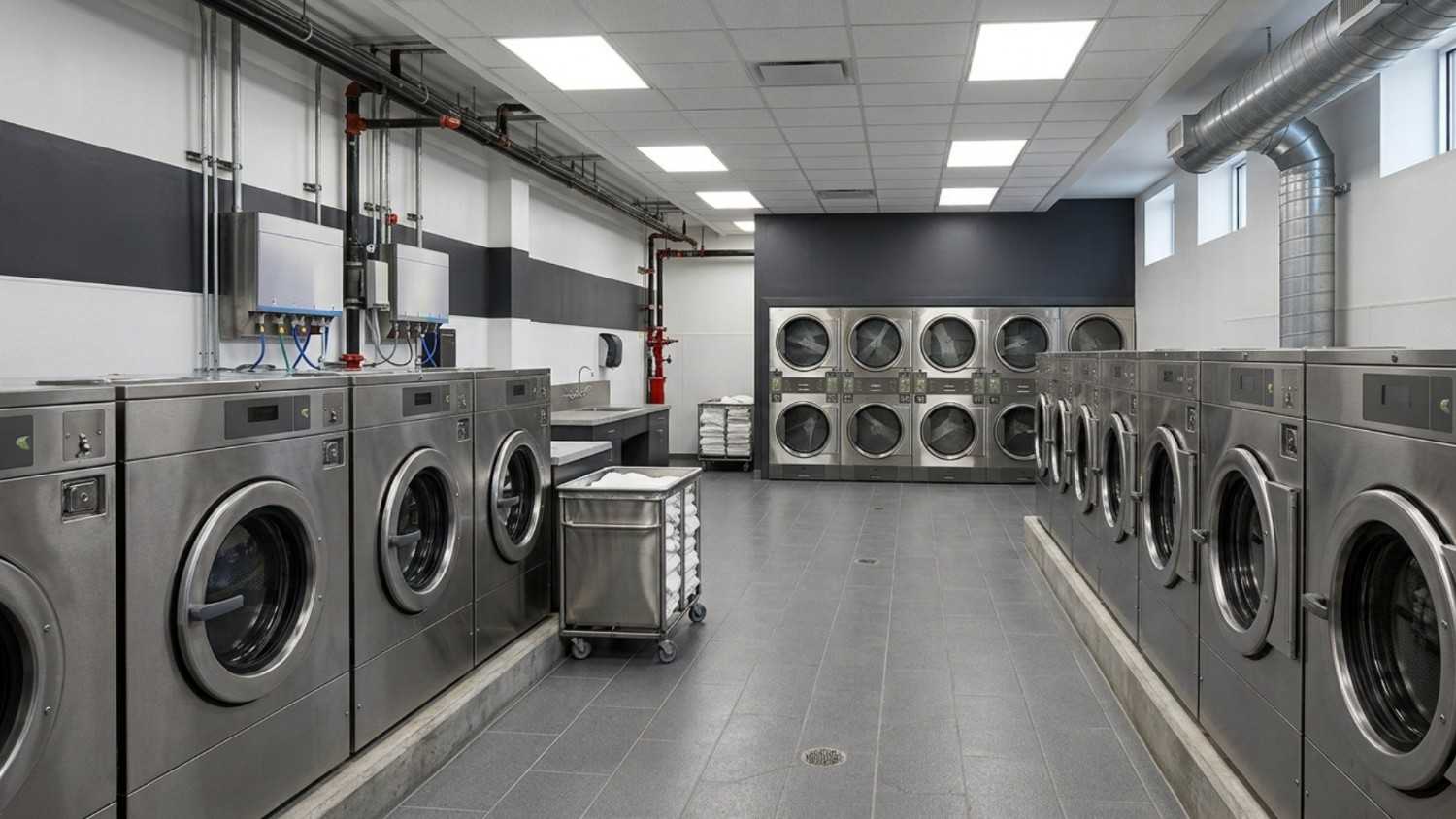
Start with a site assessment before ordering any hotel laundry room equipment. Measure equipment footprints, loading and unloading areas, linen storage, cart paths and maintenance access. The layout should also provide adequate machine clearances, door access, linen staging and clean-to-soiled separation.
Before selecting equipment, verify that the existing water, drainage, electrical and gas systems can handle multiple machines running at the same time, not just each unit in isolation. Also check ventilation, make-up air and steam requirements where applicable. Ordering equipment before reviewing these systems can lead to installation delays, added construction costs or infrastructure that cannot support the full operating load.
How Should You Choose Hotel Laundry Equipment Suppliers and Service Partners?
Choose hotel laundry equipment suppliers with proven experience serving hotels and similar high-volume laundry operations. Ask each supplier for a site-specific capacity plan and total-cost estimate. Suppliers should also show how their recommended equipment capacity matches your documented daily laundry volume and operating schedule. (ACE Commercial Laundry Equipment Inc., for example, builds that capacity plan around your documented volume before recommending a Huebsch® lineup; see our commercial laundry equipment for hotels page for the equipment we install.)
Evaluate the support package alongside the equipment itself. Installation, commissioning, staff training, warranty coverage, preventive maintenance, parts availability and service response times all affect long-term performance. Extended washer or dryer downtime can disrupt linen availability and eliminate one of the main advantages of an on-premise laundry operation.
Ask suppliers to explain how their proposed system handles your operating schedule, utility limitations and expected daily throughput. Request references from properties with similar laundry volumes and linen types. If you are comparing hotel laundry equipment for sale, review equipment specifications, installation requirements, warranty terms and ongoing service support rather than focusing on purchase price alone.
Find out how the supplier handles emergency service and what backup options exist if a critical machine goes down. Larger OPL operations may need enough redundant capacity to keep linen supply moving during repairs.
For additional guidance, see this guide to buying laundry equipment for hotels and this overview of current equipment trends.
Upgrade Your Hotel’s Commercial Laundry Equipment
Hotels with steady occupancy often benefit from an on-premise laundry system built around their daily throughput and linen inventory requirements. Properties with limited space or highly seasonal occupancy may find outsourcing more practical. The right choice depends on laundry volume, available space, utility capacity and operating costs.
As Southern California’s premier Huebsch® Laundry Dealer, ACE Commercial Laundry Equipment Inc. helps property owners evaluate these factors and select commercial laundry equipment that fits their operation. Our team serves hotels and motels throughout Southern California, including Westminster.
Call 714-640-6674 or contact us to discuss equipment options, installation requirements and laundry-room capacity for your property.
Frequently Asked Questions About Hotel Laundry Equipment
How many rooms does a hotel need to justify on-site laundry?
There is no fixed room count. The better trigger is daily linen volume: once a property generates enough soiled linen each day to keep a small bank of washer-extractors and dryers running through a full shift, the per-pound math usually favors OPL. Occupancy consistency matters as much as room count, because a smaller property at steady occupancy can justify equipment that a larger seasonal property cannot.
What kind of laundry machines do hotels use?
Most hotels run commercial washer-extractors paired with tumble dryers in matched capacities, plus a flatwork ironer at larger properties. Soft-mount washer-extractors suit upper-floor or retrofit laundry rooms because they do not need a reinforced foundation, and hard-mount units cost less up front but require a concrete pad. Properties usually run several mid-capacity machines rather than one large unit so a single breakdown does not stop the whole operation.
Should a hotel buy used laundry equipment to lower the upfront cost?
Used commercial washers and dryers can reduce the initial investment, but they carry shorter remaining service life, limited or no warranty and a higher risk of unplanned downtime. Ask for service records, cycle counts and the age of each unit, and confirm that parts remain available for the model. For a linen operation that supports daily room turns, a warrantied new machine with local service coverage often costs less over its life than a used unit that fails during peak season.
Can a hotel combine on-premise laundry with an outsourced linen service?
Yes. Some properties wash guest-room sheets and towels in-house and send low-volume or specialty items, such as banquet linens, uniforms or blankets, to an outside service. This keeps daily room-turn linen under the hotel’s control and avoids buying finishing equipment for items processed only occasionally. Track the cost per pound of each stream separately so the split stays justified as volume changes.