Hospital laundry often falls behind because wet linens move through the system too slowly. When washers leave too much water in the load, dryer output cannot keep up with linen volume, or maintenance issues go unchecked, your team ends up with drying bottlenecks that slow linen availability and put pressure on patient flow. The right commercial laundry equipment for hospitals helps fix the problem at the source by improving extraction, balancing washer and dryer output, and keeping your laundry process moving with speed, consistency, and control.
How Drying Bottlenecks Impact Patient Care and Operational Performance
Slow drying cycles create more than laundry room frustration. When clean linens arrive late, the impact reaches patient rooms, staffing schedules, utility budgets, and clinical workflows.
Slow Linen Turnover Delays Bed Readiness
When your team does not have clean linens ready on schedule, your Environmental Services staff loses valuable time waiting for replenishment. Those delays add up quickly across a busy hospital floor. If your team needs to turn over multiple rooms during one shift, every stalled linen cart can reduce available bed-hours, slow admissions, and limit your facility’s ability to respond during peak demand.
Extended Drying Cycles Create Infection Control Vulnerabilities
Slow or incomplete drying can create infection control vulnerabilities. When moisture stays trapped in textiles, linens may develop odor, mildew, or quality issues before they reach clean-linen carts. Your team then has to rewash those items, which consumes more time, energy, water, and chemicals. Worse, inefficient laundry flow increases the risk of cross-contamination when soiled and clean items move too close together, or staff rush to clear delayed loads.
Operational Costs Climb When Drying Efficiency Drops
Inefficient dryers drive up utility costs because they run longer than necessary. They also put more stress on your equipment, which can lead to more frequent repairs and unexpected downtime. When dryers fail during busy processing windows, your staff may need overtime to finish delayed loads before the next shift begins. Preventive maintenance gaps make the problem worse by turning small issues into costly disruptions.
ALSO READ: Top Troubleshooting Tips for Common Laundry Equipment Issues
Why Does Drying Become the Critical Bottleneck
Drying often becomes the main constraint in hospital laundry operations because it takes longer than washing and depends heavily on proper extraction, airflow, load size, and equipment capacity. When one part of the process falls out of balance, your clean-linen pipeline slows down.
Dryer Capacity Does Not Match Peak Demand
Many facilities experience drying bottlenecks because washers finish loads faster than dryers can process them. For example, in a typical hospital setup, the washers may eventually outpace the dryers, creating an imbalance. That imbalance forces clean, wet loads to wait for available dryer space, especially during high-volume periods such as morning bedding changes, post-surgical gown demand, and afternoon linen surges.
Drying Takes Longer Than Washing
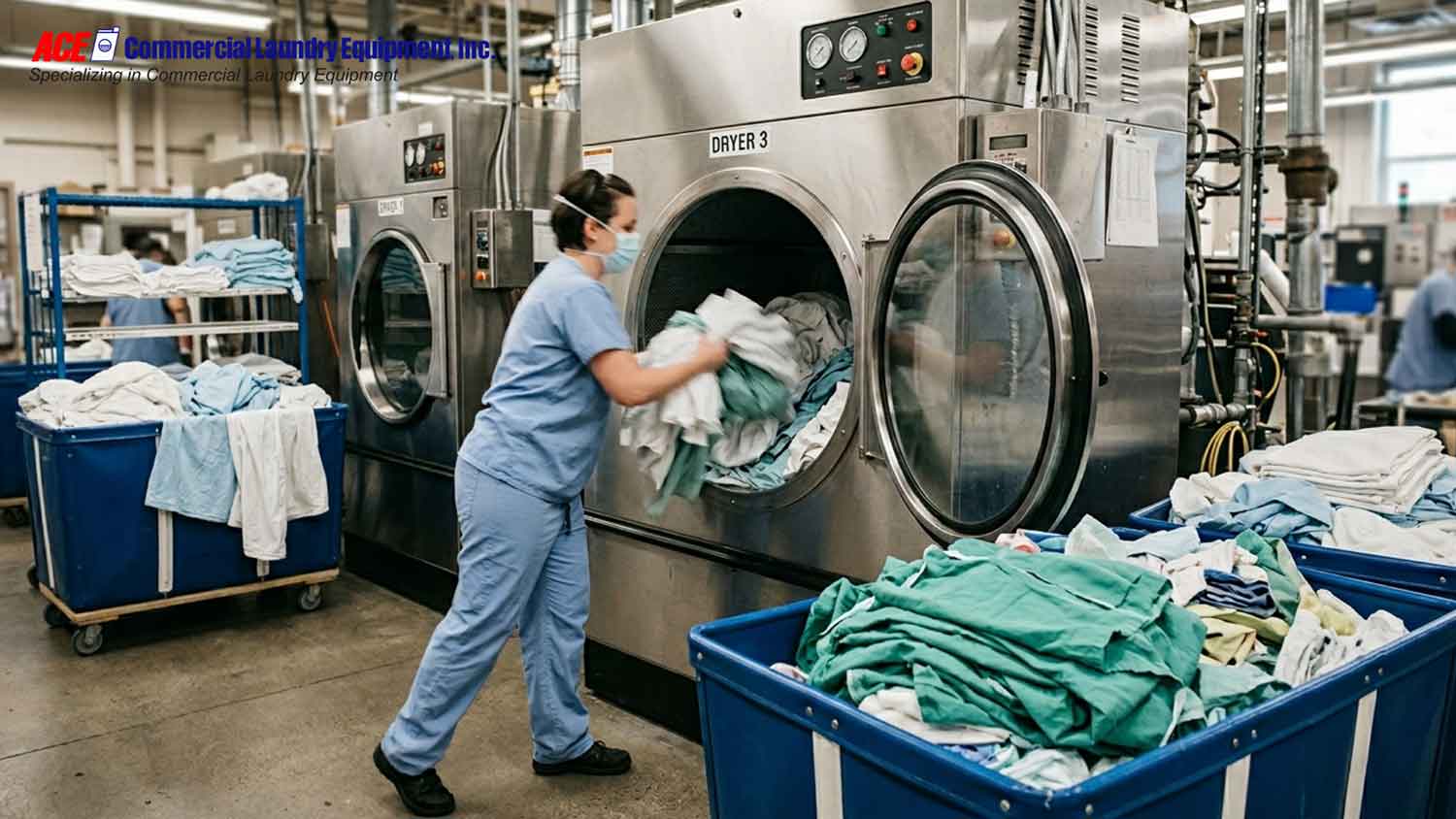
For heavy hospital textile loads, drying cycles typically take 45 to 90 minutes, while washing completes in 25 to 40 minutes. This natural capacity mismatch means each successive washer load may need to wait for the dryer to finish its cycle. When your facility processes significant daily volumes of textiles, that waiting queue can become the single largest constraint. A facility processing peak volumes at dawn may push 3,000 pounds through washing in two hours, but drying may only handle 2,000 pounds in the same window, creating a backlog that persists throughout the shift.
Workload Peaks Are Often Underestimated
Hospitals often size laundry systems based on average daily volume instead of peak-hour demand. That creates problems when your facility faces morning surges, emergency admissions, surgical turnover, or seasonal patient volume increases. Accurate planning starts with tracking soiled linen carts by the hour for at least a full week. When you understand your true peak workload, you can choose laundry equipment for hospitals that supports real operating conditions instead of falling behind when demand spikes.
Water Extraction Issues That Force Extended Drying Times
Poor extraction leaves linens too wet before they reach the dryer, which forces longer cycles and slows the entire laundry line. In many cases, your facility can reduce drying delays faster by identifying the exact cause of excess moisture than by adding another dryer.
Clogged Filters Block Airflow and Trap Moisture
This is an airflow problem: heat cannot move through the drum or vent system efficiently. When lint filters clog, or exhaust ducts collect buildup, hot air cannot circulate properly around the load. Regular filter cleaning and scheduled duct inspections help prevent restricted airflow and trapped humidity. A clean filter and clear ductwork restore the dryer’s ability to process loads at designed cycle rates.
Equipment Issues Leave Linens Too Wet
This is an extraction problem: the washer-extractor sends linens to the dryer with too much water still in the fabric. When extraction seals wear down, pulleys loosen, or hydraulic systems underperform, textiles enter the dryer heavier than they should. High-performance extraction equipment, such as commercial hospital laundry equipment with increased G-force capacity (up to 400 G-force in Huebsch OPL equipment), can reduce excess water and move more linen through your system per shift while lowering energy consumption.
Loading Errors Trap Moisture in Fabric Folds
This is a handling problem: the dryer may have enough heat, but the load blocks that heat from reaching every surface evenly. Overloaded drums prevent hot air from moving through the load, while dense items such as towels, blankets, and pads can trap moisture in folds. Your team can prevent this by loading dryers properly, separating heavy and lightweight items, and giving every load enough space for air to circulate. Better loading practices also lower rewash rates, which reduces total processing time and energy waste per garment.
The Hidden Role of Staff Training and Workflow Design
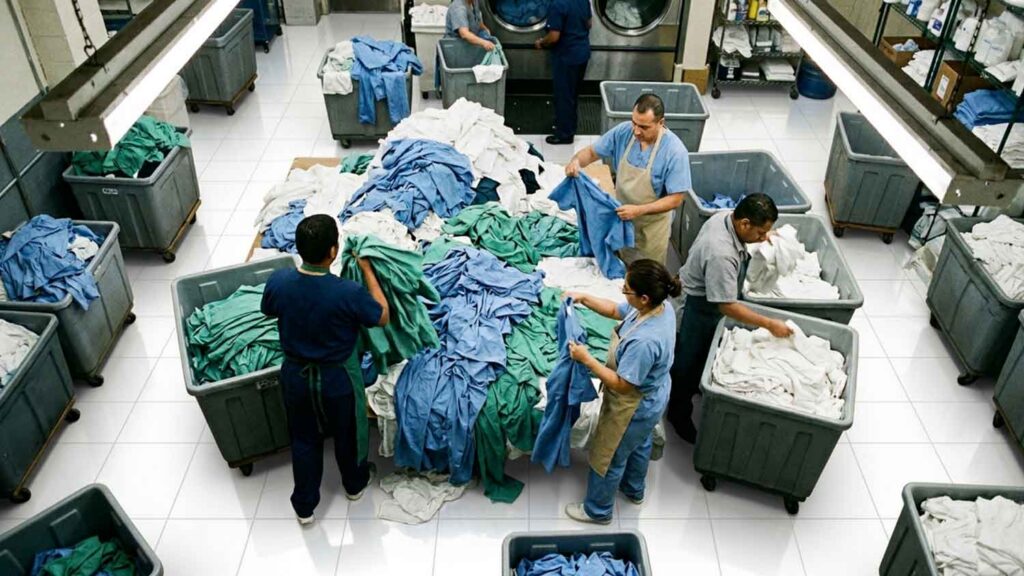
Equipment problems do not create every laundry bottleneck. Your workflow and staff habits can slow production just as much as an undersized dryer. When teams sort loads inconsistently, communicate surges too late, or skip routine accountability steps, even well-maintained hospital laundry equipment can fall behind.
Inconsistent Load Sorting and Processing
Your drying results depend on whether staff follow clear load categories before textiles reach the machine. Your team needs simple standards for separating terry, sheets, patient gowns, isolation textiles, surgical items, and specialty bedding. High-risk items, including isolation gowns and specialty bedding, also require separate handling because they often need longer wash programs and more controlled drying cycles. When every operator follows the same sorting rules, dryers run more predictably, and fewer loads need reprocessing.
Poor Communication Between Departments Causes Surprise Surges
Laundry teams work best when they can plan for volume instead of reacting to it. Without clear communication between nursing units, Environmental Services, and the laundry department, sudden linen surges can overwhelm dryer availability. Fixed pickup schedules, a shared messaging channel, or a direct line to the laundry supervisor help your team stagger incoming loads and adjust staffing before clean carts leave late. Better communication turns last-minute surprises into manageable workflow changes.
Non-Standardized Maintenance Procedures Allow Silent Failures
Small equipment issues can quietly slow your entire laundry operation when no one owns the inspection process. Your facility needs a clear checklist that assigns who checks each machine, how often they check it, and what they should do when they find wear or performance issues. Without a standard process, small failures can go unnoticed until a dryer struggles to hold temperature, airflow drops, or a washer leaves linens too wet.
Consistent preventive maintenance keeps your clean-linen pipeline moving during busy hours and reduces avoidable downtime. When equipment does fail, ACE Commercial Laundry Equipment Inc. provides 4-hour emergency service response in Southern California, helping minimize disruption during critical processing periods.
Strategic Solutions to Eliminate Drying Bottlenecks
Drying bottlenecks rarely result from a single cause. Instead, they emerge from the combined effect of extraction efficiency, airflow capacity, load matching, workflow discipline, and equipment sizing working together. Addressing each area systematically removes constraints and restores reliable linen availability.
Maximize Water Extraction Before Drying
Start by testing residual moisture after extraction. If linens consistently enter the dryer too wet, recalibrate washer-extractor speeds, inspect worn components, and consider adding extraction support for heavy textiles such as towels, blankets, and surgical items. Huebsch OPL washer-extractors with up to 400 G-force can reduce residual moisture content to 50% or lower, helping your team move more linen through finishing stages without extending dryer cycles. This is the single most effective way to reduce bottleneck delays.
Install Moisture Sensors and Variable Frequency Drives
Timer-based drying often wastes energy because it keeps running after linens have already reached the right dryness level. Moisture sensors solve that problem by stopping the dryer when the load is ready, reducing energy consumption and cycle time variance. Variable Frequency Drives, or VFDs, can also improve performance by adjusting motor speed and airflow based on demand. Huebsch moisture-sensing dryers with these capabilities help your facility reduce overdrying and keep cycle times consistent, lowering utility costs by 20 to 30% annually while improving throughput.
Enforce One-Way Workflow and Controlled Airflow
Your laundry room layout should move linens in one clear direction: soiled sorting, washing, drying, folding, storage, and dispatch. A one-way workflow means soiled carts never pass clean-linen carts, and all personnel move in the same direction through each stage. Controlled airflow adds another layer of protection by designing your ventilation so positive air pressure on the clean side pushes lint and moisture toward the washer area, preventing them from drifting back toward folded or ready-to-use linens. This physical design prevents cross-contamination at the source and eliminates the need for staff to manually correct misdirected loads. The result is faster throughput and stronger infection-control compliance.
Build Cross-Training and Measure Results
Cross-training gives your laundry operation more flexibility during busy periods. When at least two team members can operate each major machine or station, your facility can absorb sudden rushes without slowing production or relying on overtime. Track results such as bed-turn time, rewash rates, dryer cycle length, utility usage, and hospital-acquired infection trends.
When your nursing, Environmental Services, and laundry teams can see the same performance metrics, they can solve problems together instead of working in separate silos. Facilities that implement these changes typically see rewash rates drop by 15 to 20% and average cycle times improve by 25 to 35%, translating directly to faster bed availability and lower operational costs.
Right-Size Your Equipment Investment
Once you know your busiest processing windows, match dryer capacity, washer-extractor output, and finishing equipment to that real demand. This helps your facility avoid both undersized systems that create delays and oversized systems that waste space, utilities, and capital. If your facility faces temporary surges, you can also use mobile laundry support or outsource bulk items such as sheets and blankets to a healthcare laundry provider while keeping critical items in-house.
ALSO READ: How to Choose the Right Laundry Equipment for Your Industry
Transform Your Laundry Operation
Drying bottlenecks usually result from a combination of extraction, airflow, capacity, loading, and workflow issues. ACE Commercial Laundry Equipment Inc. helps Southern California healthcare facilities identify these constraints, align laundry systems with actual operating demand, and select right-sized commercial laundry equipment for hospital operations. We also provide on-site facility assessments and 4-hour emergency service support to help keep your linen pipeline moving. To schedule an assessment, contact ACE Commercial Laundry Equipment Inc. at 14404 Hoover St, Westminster, CA 92683, or call 714-640-6674.
Frequently Asked Questions
What linen standards and quality requirements apply to hospital laundry operations?
Hospital laundry operations must follow infection-control and textile-processing guidelines from organizations such as the Association for the Advancement of Medical Instrumentation (AAMI) and the Centers for Disease Control and Prevention (CDC). These standards help your facility control water temperature, chemical use, soil removal, textile quality, and clean-linen handling. Your team should maintain validated wash programs, proper chemical dosing, clear handling procedures, and documentation for regulatory audits.
How do I choose the right hospital laundry equipment supplier for my facility?
Choose a hospital laundry equipment supplier with proven healthcare laundry experience, strong service support, and the ability to assess your facility in person. Your supplier should evaluate equipment capacity, workflow layout, clean-linen handling requirements, maintenance needs, and long-term service expectations before making recommendations.
If you are comparing hospital laundry equipment for sale, look beyond the machine price and confirm whether the supplier can support installation, training, preventive maintenance, and future capacity needs. ACE Commercial Laundry Equipment Inc. specializes in helping facilities right-size their operations to match actual demand, ensuring you invest in equipment that solves your bottleneck rather than undersizing or oversizing your system.
Should our hospital outsource laundry services instead of investing in commercial laundry equipment?
Your hospital should compare outsourcing with in-house laundry based on volume, space, staffing, budget, turnaround needs, and quality-control expectations. Outsourcing may work well for smaller facilities or hospitals with limited space. In-house laundry often gives larger facilities more control over linen availability, turnaround time, quality checks, and specialized textile handling when they use properly matched washer-extractors, dryers, and finishing systems.
Many facilities benefit from a hybrid approach, outsourcing bulk linens while keeping critical items such as surgical textiles and isolation gowns in-house. ACE Commercial Laundry Equipment Inc. can help you conduct an accurate assessment of your facility’s capacity and cost structure so you can evaluate the outsourcing comparison fairly.
How frequently should commercial laundry equipment for hospitals be serviced and maintained?
Your team should check equipment daily, complete deeper inspections weekly, and schedule professional preventive maintenance at least quarterly for high-volume hospital operations. Daily checks usually include lint filters, gaskets, and visible wear. Weekly and quarterly service should cover airflow, temperature controls, pumps, valves, belts, dryer vents, washer-extractor performance, and safety systems.
Most manufacturers, including Huebsch, recommend annual deep service for major components such as dryer vents, extraction bearings, and steam systems. A preventive maintenance schedule keeps equipment running reliably and can extend service life by 5 to 10 years. When unexpected failures do occur, ACE Commercial Laundry Equipment Inc. provides 4-hour emergency response to minimize your downtime.
What water temperature is required to sanitize hospital linens?
CDC guidelines recommend washing healthcare textiles at a minimum of 160°F (71°C) for at least 25 minutes to achieve proper disinfection for standard ward linens. However, some validated low-temperature chemical programs can achieve equivalent disinfection at lower temperatures when paired with appropriate chemical disinfectants and extended contact time.
The required water temperature ultimately depends on your facility’s infection-control policy, fabric type, soil level, chemical program, and equipment setup. Your infection-control team and hospital laundry equipment suppliers should confirm the exact thermal and chemical requirements your facility must maintain to meet CDC standards and your state’s healthcare regulations.