Choosing a laundry provider comes down to what directly affects your building: service coverage, repair response times, equipment quality, payment systems, contract terms, reputation, and forward-ready technology. The right partner protects your revenue, reduces tenant complaints, and keeps utility costs predictable. The wrong one locks you into years of slow repairs, unclear billing, and missed income.
Before you sign, ask direct questions about maintenance timelines, revenue sharing, billing transparency, machine upgrades, and post-installation support. A capable commercial laundry equipment partner gives you reliable machines, clear terms, responsive service, and a plan that supports your operation for the full contract term.
What a Commercial Laundry Room Management Provider Should Deliver
Before you compare pricing or features, define what your operation actually needs. Every company structures service differently, so your model has to fit your staffing, budget, and resident expectations. A clear scope upfront prevents confusion later.
Full-Service vs. Maintenance-Only Scope
A full-service lease delivers a complete laundry room solution. The provider handles machine selection, installation, maintenance, collections, and reporting. You contribute the space, and the partner runs the operation. This model fits properties without the capital to purchase machines or the staff to maintain them.
A maintenance-only contract works differently. You own the commercial laundry machines, and the service company keeps them running. This option suits owners who want to keep all laundry revenue and have the budget to buy equipment outright.
Specialization in Your Property Type
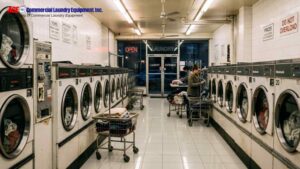
A capable vendor understands how your facility uses laundry equipment. Multifamily communities, hotels, and healthcare facilities all have different demands, usage patterns, and accessibility requirements, including ADA-compliant machine placement in shared laundry rooms.
Multifamily housing often needs one washer-dryer pair for every eight to ten units. Hotels process heavier loads in shorter time windows. Healthcare facilities need strict soil-side and clean-side laundry workflows. When you interview providers, find out how many comparable properties they service in your region. A strong local portfolio matters more than years in business alone.
Transitioning From Your Current Provider
Switching providers is often the real starting point of any evaluation. Find out who handles the removal of existing commercial laundry equipment, how the new install is scheduled, and what the timeline looks like end-to-end. A standard transition runs 30 to 60 days from contract signing to fully operational machines.
Coordination with the outgoing vendor matters as much as install speed. The new partner should manage resident communication during the changeover, sequence machine swaps to minimize downtime, and confirm continuity of cashless payment platforms so residents aren’t locked out mid-cycle.
ALSO READ: How to Evaluate a Commercial Laundry Equipment Company Before Buying
Service Reliability and Response Time
Downtime creates resident complaints and pulls your team into laundry issues they shouldn’t have to handle. You need a commercial laundry partner that treats repair response as a core responsibility, not an afterthought.
Repair Turnaround Standards
Document the service commitment in the contract: 24 to 48 hours for standard repairs, with same-day or next-business-day response for outages affecting multiple machines. Verbal promises offer no protection when a bank of machines fails on a holiday weekend.
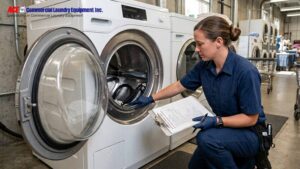
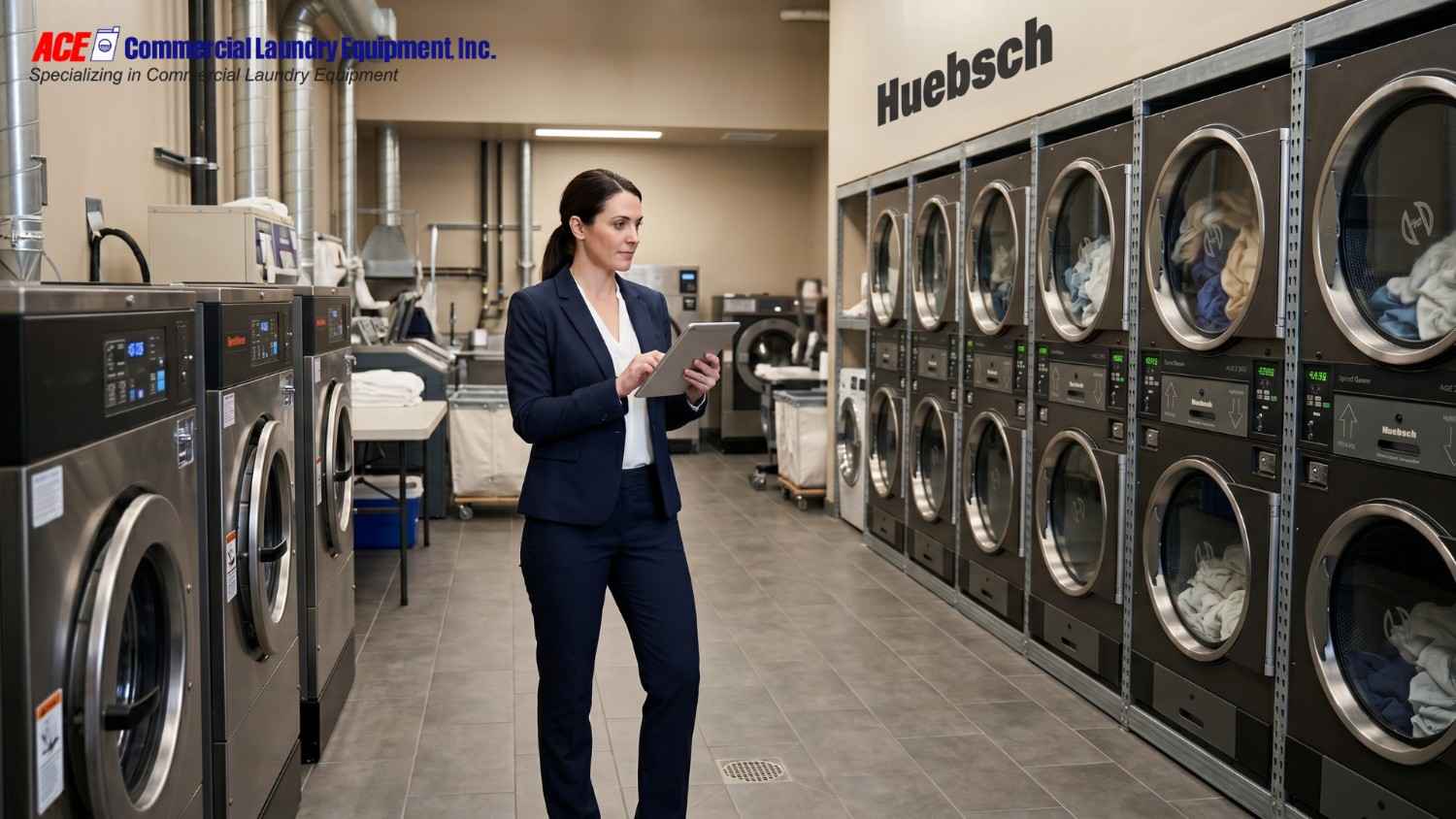
A serious dealer should commit to a tighter bar than the industry baseline. ACE Commercial Laundry Equipment Inc. backs critical repairs with a 4-hour response standard, which is what a multifamily or hospitality operation needs when revenue and resident satisfaction are both on the line. Factory-trained technicians matter as much as response speed. A technician trained on Huebsch equipment diagnoses problems faster, brings the right parts on the first visit, and reduces repeat visits.
Resident-Direct Service Reporting
Modern providers let residents report problems directly through a QR code, mobile app, or service phone line. This keeps your property manager out of the middle position between residents and the repair team.
Direct reporting shortens the gap between breakdown and dispatch. Residents get a faster fix, machines stay available, and your staff spends less time chasing service updates.
Equipment Quality and Performance
The equipment installed today sets the standard for utility costs, machine lifespan, and daily performance for the next decade. Strong choices upfront protect your operation from high energy bills, frequent repairs, and underperforming machines.
High-Efficiency, Commercial-Grade Machines
Commercial-grade machines are built for daily, high-cycle use. Residential-style machines placed in commercial casings cannot keep up. The best commercial laundry machines carry ENERGY STAR certification and use less water and energy without sacrificing performance.
Front-load washers with 200 G or higher extraction speeds pull more water out of every load during the spin cycle. The result is shorter drying times, lower gas and electric costs, and faster machine turnover for residents.
With proper maintenance, premium commercial laundry machines are built for years of heavy daily service. Confirm the warranty terms in writing, including coverage for the motor, transmission, electronic controls, and other major components.
Smart Monitoring, Predictive Maintenance, and Energy Efficiency
Modern laundry rooms run on real-time visibility. Networked machines track cycle counts, error codes, and usage data, which lets the service team schedule preventive maintenance and diagnose problems faster.
Prioritize machines with IoT monitoring, predictive maintenance alerts, and energy-efficient operation. A system that automatically creates a service ticket the moment a machine throws an error code delivers far more value than one that only sends a monthly summary report.
RELATED ARTICLE: How to Make Your Laundry Room More Eco-Friendly
Payment Systems and Resident Experience
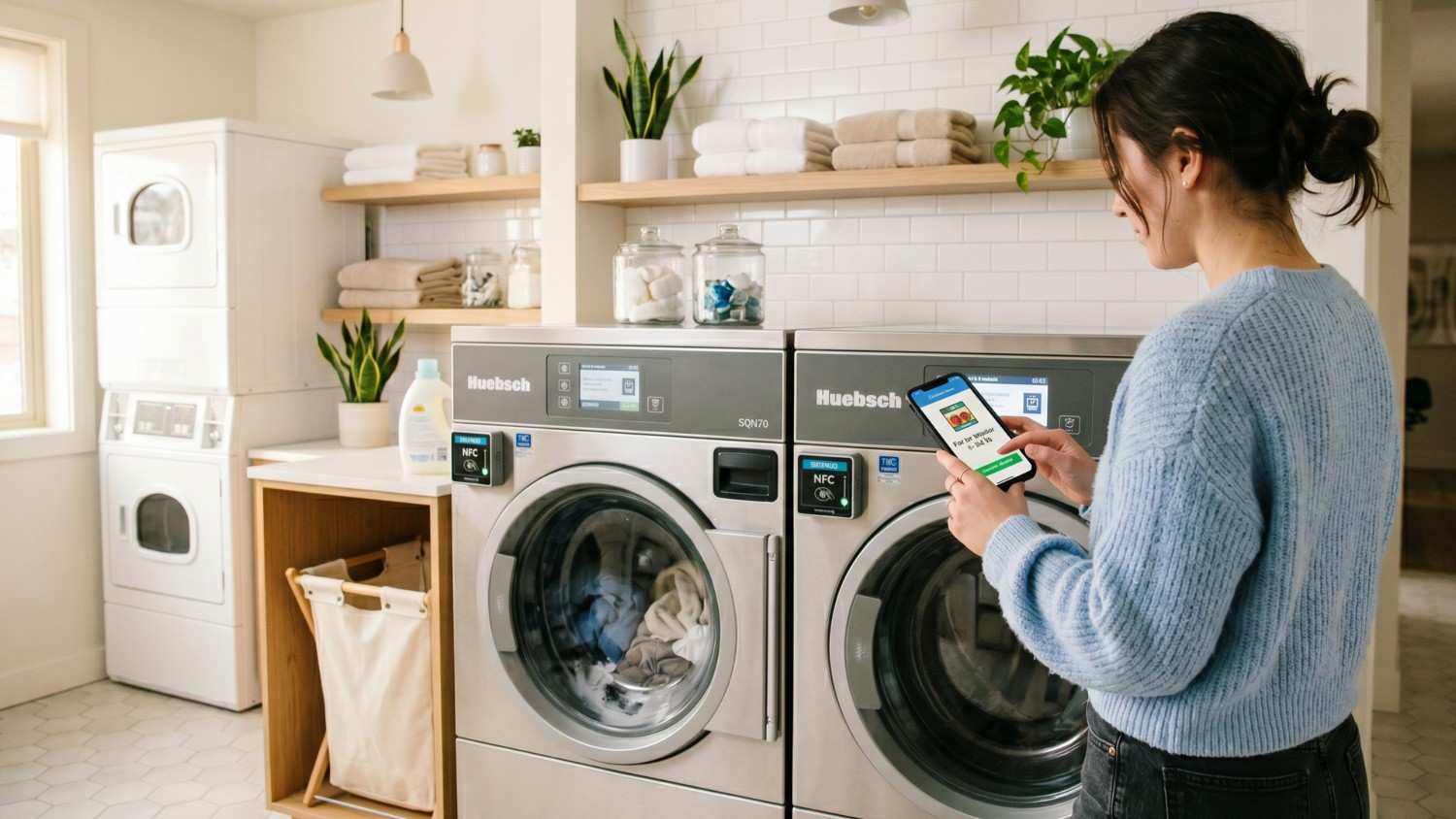
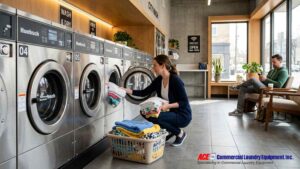
Your residents expect laundry payments to be as simple as every other transaction in their day. Coin-only systems create friction, increase collection labor, and make the laundry room harder to use.
Cashless and App-Based Payments
Mobile apps, credit cards, debit cards, and contactless payments simplify the experience for residents. They also eliminate coin collection and reduce the security risks that come with on-site cash.
Review the supported payment platforms before you commit. ACE works directly with PayRange, SpyderWash, KioSoft, CCI, and other major systems, so residents can use the platform they already trust.
Beyond payment, look for machine availability alerts, cycle completion notifications, and in-app reservations. These features reduce wait times during peak hours, cut front-desk questions, and improve resident satisfaction in mobile-first communities.
Contract Transparency and Revenue Structure
Property managers often discover contract problems too late. Review the legal and financial terms with the same care you’d apply to any long-term vendor agreement.
Revenue Split, Reporting Access, and Payout Cadence
Revenue-share agreements vary widely. The exact split needs to be documented, along with the definitions of gross and net revenue and the payout schedule.
Clear statements should show machine-level usage, payment volume, and monthly payout details. Live dashboards are now standard for professional laundry room management. Request a sample monthly revenue statement during your evaluation period so you can see the data visibility before you sign.
Quarterly PDF statements are a warning sign. A company that cannot deliver transparent documentation often runs into problems with payouts, deductions, and accountability later.
Maintenance and Parts Responsibility
A full-service lease should cover normal repairs, parts, and labor. Still, you need to know what falls outside that scope. Vandalism, water damage, misuse, or owner-caused damage typically trigger extra charges.
Secure the out-of-scope rate sheet in the contract. Knowing the cost of a service call before a problem happens prevents disputes after the invoice arrives.
Insurance, Licensing, and Liability
Liability coverage is a standard vendor evaluation criterion that property managers often overlook. Water damage incidents, technician injuries on-site, or installation defects can expose your operation if the provider’s coverage is insufficient.
Verify general liability coverage with limits appropriate for your property scale. Confirm workers’ compensation coverage for any technician working on-site, contractor licensing for installation scope, and a certificate of insurance that names your property as additional insured.
Exit Clauses and Term Flexibility
Most commercial laundry equipment contracts run five to ten years. Read the renewal language closely. Automatic renewals, narrow termination windows, and high cancellation fees can lock your operation into a bad agreement for years past the original term.
Negotiate performance-based exit clauses tied to uptime, response times, or repeated service failures. A confident provider stands behind its service with clear accountability written into the deal.
Reputation, References, and Track Record
A company’s marketing can promise anything. Real clients tell you what actually happens once the machines are installed and the contract begins. Long-standing, family-operated dealers also carry institutional knowledge that newer or PE-backed vendors often lack.
Client References in Your Sector
Request three references from properties similar to yours in size, age, and type. Then call them. Ask about repair response times, surprise charges, statement accuracy, and how the company handled the worst service issue in the past year.
Generic praise reveals little. Specific stories about real problems and how they were resolved show whether the company can support your operation.
Independent Reviews and Case Studies
Check Google reviews, Yelp, and relevant industry forums. Patterns matter more than any single review. Repeated complaints about slow repairs, poor communication, or billing issues deserve attention.
The company’s own case studies also tell a story. Named clients, documented uptime, clear project scope, and measurable performance results carry far more weight than vague testimonials.
A Quick Evaluation Checklist Before You Sign
Before you commit to any laundry equipment lease, purchase agreement, or management contract, confirm every item below:
- Written repair response service-level agreement with a 24- to 48-hour target
- Equipment list with ENERGY STAR certifications and full warranty terms
- Cashless payment system with a live revenue dashboard
- Clear revenue split, payout schedule, and sample statement
- Written maintenance scope and out-of-scope rate sheet
- Certificate of insurance with your property listed as additional insured
- Contractor licensing verified for installation scope
- Exit clauses and renewal terms that protect your operation
- Three sector-specific client references contacted directly
- Review patterns checked across multiple platforms
Missing details are negotiating opportunities. Every promise belongs in writing before you commit your operation to a long-term provider.
Ready to Upgrade Your Laundry Room?
Your laundry room should make life easier for your residents and your team. As a third-generation Southern California dealer, ACE Commercial Laundry Equipment Inc helps properties evaluate, upgrade, and manage commercial laundry equipment with clear service terms, a 4-hour critical response standard, and zero upfront cost options for qualified properties. If you want to compare your current setup, review commercial laundry equipment for sale, or explore a new install, contact us at 14404 Hoover St, Westminster, CA 92683, or call 877-630-7278 for a no-pressure consultation.
Frequently Asked Questions
How long do commercial laundry management contracts typically last?
Most full-service leases run five to ten years to allow the provider to recover equipment costs. Shorter agreements may be negotiable for smaller installations or upgrade-in-place projects.
What is a typical revenue-share percentage for multifamily laundry?
Splits vary based on equipment investment, property size, and service scope. Request the exact percentage in writing, confirm whether it applies to gross or net revenue, and review a sample monthly statement before signing.
Can I switch laundry providers mid-contract?
Mid-contract exits depend on your existing agreement. Performance-based exit clauses tied to uptime or response-time failures give you the strongest position. A new provider should walk you through equipment removal, install timing, and resident communication during the changeover.
How fast should a provider respond to a service call?
Industry standard is 24 to 48 hours for routine repairs and same-day or next-business-day response for multi-machine outages. Dealers that commit to a 4-hour response on critical failures set the higher bar.