Choosing the wrong commercial laundry equipment company creates long-term operational risk. Poorly built machines, delayed service calls, and escalating utility costs create ongoing financial strain, turning routine operations into constant damage control. These failures do not stay isolated; they disrupt staff productivity, strain customer relationships, and erode profit margins.
The right company delivers consistent performance, responsive service, and equipment engineered for efficiency and longevity. This blog explains how to evaluate a commercial laundry equipment company before you commit, outlining what separates reliable partners from costly mistakes. Use this framework to make a disciplined purchase decision that protects uptime, controls expenses, and supports your operation for the long run.
What a Company’s Track Record Tells You About Future Performance
A company’s track record reveals how it has performed under real operating pressure over time. Years of installations, long-term customer relationships, and sustained manufacturer authorization show whether a dealer delivers consistent results or simply cycles through short-term wins. Review this history before you compare equipment models or pricing.
Years in Business and Manufacturer Partnerships
Long-standing manufacturer partnerships signal consistency and reliability. A commercial laundry dealer that has remained an authorized partner with brands like Huebsch for decades earned that status through dependable results, not short-term sales. Dealers with over 10 years of uninterrupted manufacturer authorization have weathered economic downturns, supply chain disruptions, and technology shifts, and that longevity is a strong reliability signal. If a dealer can’t show at least five continuous years with their primary brand, dig into why.
Verify the timeline. Ask how long the company has held manufacturer authorization and whether that status has remained uninterrupted. Long-standing partnerships indicate a dealer that adapts to new technology and maintains performance standards over decades of installations, ensuring consistent support and access to factory-trained technicians, priority parts availability, and ongoing certification.
Customer Reviews and Real-World References
Online reviews offer a starting point, but direct references provide clarity. Ask for contacts at operations similar to yours. A laundromat, hotel, and healthcare facility each expose different operational realities that reveal how a company performs once equipment is in daily use.
Use direct questions:
- How fast did the company respond during breakdowns?
- Did the installation stay on schedule?
- Did support remain consistent after the sale closed?
Those answers tell you how the company treats customers once contracts are signed.
Industry Involvement and Professional Credibility
Industry involvement reinforces credibility built over time. Participation in trade organizations and educational forums shows that a company stays aligned with evolving standards, regulatory shifts, and operational best practices. Long-term operators build these connections naturally as part of sustained industry presence.
RELATED ARTICLE: What to Look for When Choosing a Commercial Laundry Equipment Supplier
Service and Support Infrastructure That Protects Your Investment
Once commercial laundry machines are installed, service execution determines whether your operation runs smoothly or absorbs ongoing disruption. This section focuses on how a company performs today: how quickly it responds, how efficiently it repairs equipment, and how it prevents avoidable failures that disrupt daily output.
Emergency Response and Local Service Coverage
Local, in-house service coverage becomes critical the moment equipment goes down. Dealers relying on subcontracted technicians can’t provide the same level of speed or accountability as a dedicated, local service team. When machines break down mid-shift, the immediate impact includes missed turns, staffing bottlenecks, and service delays that directly affect operations.
Ask direct questions during your evaluation:
- How quickly do you typically respond to emergency service requests?
- Are technicians based locally, or are they dispatched from a centralized location?
- What is your process for providing support after regular business hours?
In most commercial laundry operations, a same-day response window is the minimum standard. Dealers that guarantee a 4-hour response time for critical failures are setting a higher bar. If a company can’t commit to a specific response window in writing, that’s a red flag.
OEM Parts Availability and Repair Turnaround
Repair speed depends on parts access. A company that stocks original manufacturer parts completes repairs faster and avoids compatibility issues that extend downtime. Ask about inventory depth, lead times for high-failure components, and confirmation that repairs use approved parts.
Consistent use of genuine parts protects repair accuracy and supports warranty compliance, reducing repeat failures and service interruptions.
Preventive Maintenance Programs and Staff Training
The best commercial laundry machines rarely need emergency repairs because their owners invest in preventive maintenance. For machines running over 8 hours daily, quarterly preventive maintenance is standard. High-volume operations (over 12 hours daily) should target bi-monthly service intervals. If a dealer’s maintenance program doesn’t scale to your usage level, it’s likely just a scheduling template, not a true program.
Ask what scheduled maintenance programs include, how frequently service occurs, and how programs are priced. Preventive care stabilizes performance through heavy daily use and limits unplanned disruptions.
Installation support and staff training matter just as much. Ensure that the company conducts a thorough site assessment before installation and provides your team with proper training on equipment operation and basic troubleshooting. Knowledgeable operators help reduce unnecessary service calls and maintain smooth operation between service visits.
READ MORE: A Practical Guide to Choosing Commercial Laundry Equipment for Long-Term Growth
How to Evaluate Equipment Quality Beyond the Spec Sheet
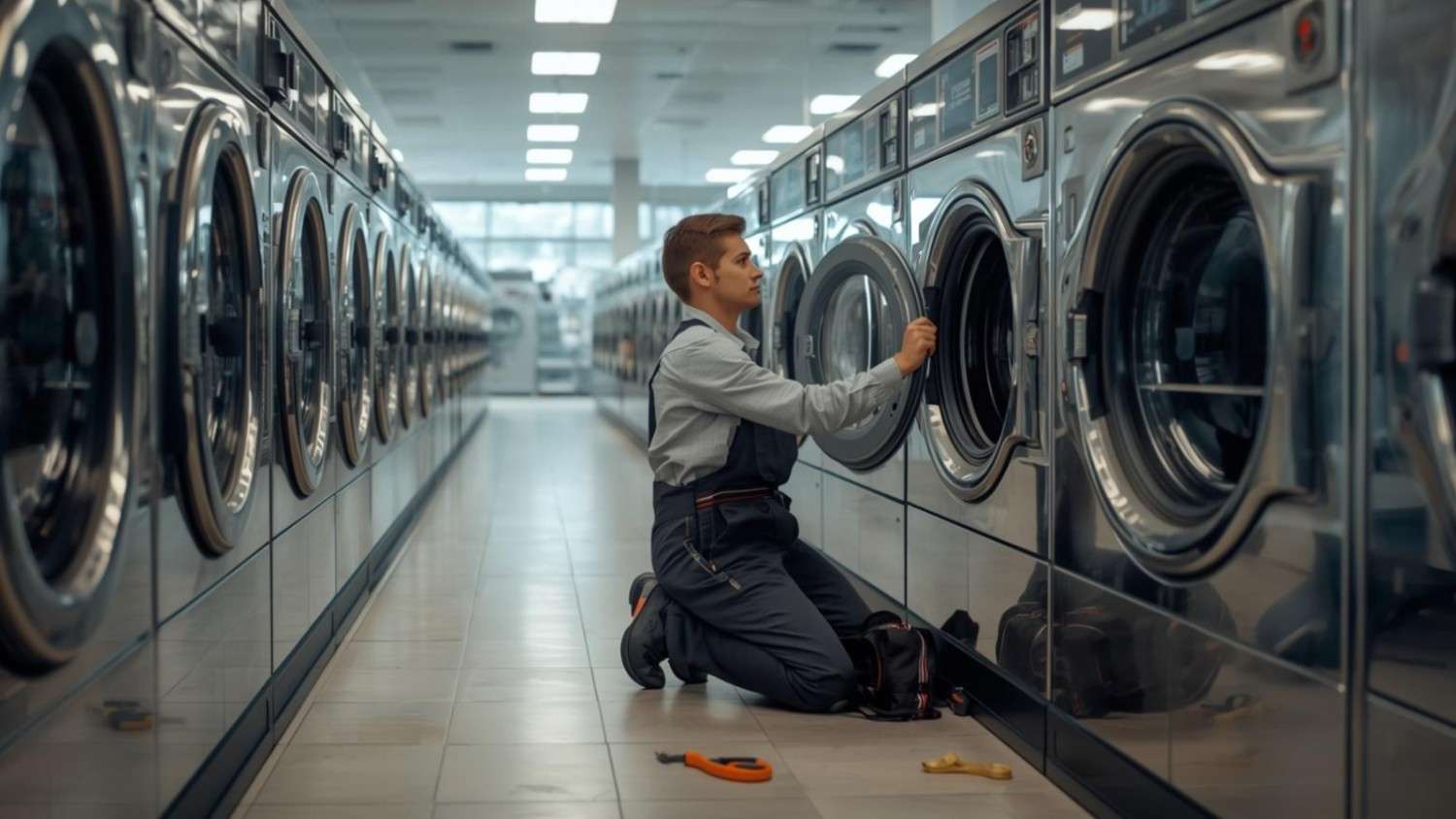
Specifications help you compare machines, but performance under real workloads determines value. Equipment built for sustained commercial use maintains output after thousands of cycles, not just during the first months of operation.
Construction and Durability Benchmarks
True commercial-grade machines use stainless steel drums, reinforced frames, and components rated for continuous duty. Residential-grade internals fail quickly under commercial volume, regardless of marketing claims.
Focus on the extraction force and core components. High G-force extraction at 200G or higher removes more water per load and shortens drying time. Ask about bearing ratings, suspension systems, and expected service life based on your projected daily volume. These details show whether the machine is engineered for heavy use or priced to appear competitive.
Efficiency Ratings Worth Comparing
Two metrics drive long-term operating cost: water factor and modified energy factor. Target a water factor below 4.0 and a modified energy factor above 2.0. ENERGY STAR certification sets a baseline, but it does not replace side-by-side comparison of real performance data.
Request full spec sheets for each machine you are considering. Compare water and energy consumption per cycle. Even small efficiency differences will add up significantly over time, impacting your operational costs and overall efficiency. This should be weighed alongside build quality and brand reliability.
Technology and Controls That Match Your Workflow
Control systems shape daily efficiency. Programmable cycles support compliance in healthcare, simplify customer use in laundromats, and standardize linen care across hospitality shifts.
Remote diagnostics and digital payment systems now affect uptime and revenue directly. Monitoring tools reduce unnecessary service calls, and app-based payments increase revenue per machine in vended environments. Confirm that the dealer installs, integrates, and services these systems after purchase.
ALSO READ: Best Commercial Laundry Equipment and Brands
Calculating Total Cost of Ownership Before You Commit
Purchase price represents only a portion of what the equipment costs to operate. Utilities, maintenance, and repair frequency over a defined operating window determine whether an investment supports or erodes margins.
Lifecycle Cost Breakdown: Purchase, Utilities, and Maintenance
Start with a complete financial model. While purchase or lease terms set the initial cost, utilities and maintenance costs become the larger factors that drive total expenses over 10 to 15 years.
Ask for side-by-side cost projections between equipment options. Apply efficiency data to your actual water, gas, and electric rates. Translating specifications into monthly operating costs exposes real financial differences.
Warranty Coverage and What It Actually Protects
Warranty terms vary widely. Compare parts-only coverage with parts-and-labor protection. Pay particular attention to the warranty duration for key components such as motors, bearings, control boards, and drums. Leading manufacturers typically cover these critical parts for five to ten years.
Clarify warranty conditions before installation. Some require authorized service for all maintenance. Others enforce water quality or electrical standards. Dealers should explain these requirements clearly and help configure their site to remain compliant.
Financing and Leasing Options That Fit Your Cash Flow
Cash purchases are not always optimal. Leasing preserves working capital and may offer tax advantages depending on business structure. Many dealers offer financing programs designed for laundry operations, including flexible terms and upgrade paths.
Ask for a return-on-investment projection based on your operation. Most commercial laundry installations recover costs within three to five years through utility savings and higher throughput. Projections should reflect your volume, utility rates, and equipment mix.
Your Pre-Purchase Checklist
Use this checklist to apply the framework consistently before finalizing any agreement.
- Capacity requirements: Define your needs based on daily volume, peak loads, and realistic growth projections for the next five to ten years.
- On-site consultations: Schedule visits with at least two dealers to compare expertise, recommendations, and their ability to customize solutions for your space.
- Local service coverage: Confirm the availability of local technicians, typical response times for emergencies, parts inventory depth, and how after-hours support is handled.
- Utility cost projections: Collect machine-specific estimates calculated using your actual water, gas, and electric rates.
- Warranty terms: Ensure the warranty includes both parts and labor, and verify the coverage duration for essential components like motors, bearings, and control boards.
- Financing and ownership cost: Review financing options and calculate the total cost of ownership over a ten-year period for each machine.
- Operational references: Speak with customers who run facilities similar to yours in size, industry, and daily volume.
Work With a Company That Checks Every Box
Every standard in this guide leads to the same conclusion: reliable outcomes come from alignment between experience, service execution, equipment quality, and financial clarity. When those elements work together, operations remain stable through the full life of the equipment.
ACE Commercial Laundry Equipment Inc. has delivered that full-spectrum support across Southern California. As an authorized Huebsch dealer, we provide factory-trained technicians, a complete OEM parts inventory, and financing options built for commercial operations. Our partnership starts with a thorough site evaluation and extends through proactive maintenance to ensure your equipment performs efficiently over its entire lifecycle.
Looking for commercial laundry equipment for sale that meets every benchmark covered here? Contact ACE Commercial Laundry today for a free consultation or request a service visit to see the difference a dedicated partner makes.