Water prices are rising across Southern California, and laundromat owners, hotel operators, and property managers are feeling the impact. High-volume laundry facilities are especially vulnerable, as utility bills often eat into their profits. The good news? Modern commercial laundry equipment can cut water consumption by 50-85% compared to older models.
In this blog, you’ll discover practical strategies you can start using today. You’ll learn how upgrading to more efficient commercial laundry machines can save thousands of gallons of water each month. We’ll also cover simple operational changes that cost nothing but deliver measurable results.
With the right equipment and processes, your commercial laundry operation can balance clean results with water conservation.
Why Water Efficiency Matters for Commercial Laundry Operations
Before exploring solutions, it’s important to understand why water efficiency is crucial now. Water usage directly impacts your bottom line and can make your facility more competitive as regulations become stricter and tenant expectations shift.
The Real Cost of Water Waste in High-Volume Facilities
Inefficient commercial laundry equipment can drain your budget quickly. For instance, running 20 loads daily on outdated machines can add up to tens of thousands of gallons of water used each month. Add in the energy needed to heat that water, and operational costs rise even more.
The financial impact varies depending on your facility’s size, but the pattern stays the same: machines that use higher water volumes drive up operating costs every day. High-turnover facilities see the biggest gains when shifting to more efficient options, often saving thousands of dollars each year.
Here’s the simple calculation: every gallon saved is money retained. Water consumption per cycle should be a top consideration when evaluating new commercial laundry equipment.
Sustainability Pressure from Tenants and Regulations
While cost savings are a major reason for efficiency upgrades, external pressures are making these changes even more important. California’s water restrictions affect commercial users during droughts, and properties pursuing green building certifications need to prove their efficiency. Additionally, tenants increasingly expect environmentally responsible amenities.
Equipment that lacks modern efficiency features can give tenants or guests the impression that a property isn’t keeping up with current sustainability standards. Upgrading to newer commercial laundry equipment shows a commitment to responsible resource use and can positively influence leasing decisions and guest satisfaction.
Why water efficiency matters:
- Save money with upgraded, efficient commercial laundry equipment.
- Meet tenant expectations for eco-friendly amenities.
- Stay ahead of regulations and California’s water restrictions.
Upgrade to High-Efficiency Commercial Washers
The right equipment forms the backbone of any water-saving strategy. Process improvements help, but machines designed with older technology can only go so far in reducing water use. The best commercial laundry machines use advanced systems that work together to maximize efficiency.
Front-Load vs. Top-Load Water Consumption
The design differences between front-load and top-load washers create a significant gap in water usage. Here’s how the two compare:
- Top-load washers: Fill the entire tub with water, submerging clothes completely, which leads to higher water usage (35-50 gallons per cycle). They require more water to clean a load effectively, using the traditional wash method of soaking and agitating clothes.
- Front-load washers: Use a tumbling action to clean clothes in a smaller volume of water (15-25 gallons per cycle). Clothes pass through the water repeatedly, making them cleaner while using up to 50% less water. The tumbling motion is more efficient, and since the water is recycled in the drum, less is needed.
This design difference not only saves water but also energy. Front-load machines extract more moisture during the spin cycle, reducing drying time and energy consumption. The lower water factor rating on front-load washers means they use significantly less water per cubic foot of capacity, delivering further savings.
Load-Sensing and Weighing Technology
Not every load fills the drum completely. In facilities with variable usage patterns, machines often fill to fixed levels, wasting water for smaller loads.
Load-sensing technology solves this issue. The sensors weigh or measure each load, adjusting the water level automatically. Here’s how it works:
- Full drum: The machine fills to full capacity.
- Partial load: The machine uses only the water needed for a half-full drum.
This prevents small loads from using the same water levels as full ones. Facilities with fluctuating usage patterns benefit the most, especially property managers serving residential tenants.
ENERGY STAR Certification and What It Means
ENERGY STAR certification indicates that commercial laundry equipment meets federal efficiency standards verified through independent testing. Certified washers use at least:
- 25% less energy than standard models.
- 45% less water than regular machines.
Beyond energy and water savings, ENERGY STAR certification often makes equipment eligible for utility rebates and incentive programs. In Southern California, utility providers offer commercial rebates that help offset upgrade costs. Additionally, the certification simplifies compliance for properties pursuing sustainability credentials.
When you’re choosing the best commercial laundry machines for your facility, ENERGY STAR certification should be your go-to benchmark. It helps you easily compare water factor ratings across certified models and select the equipment that fits your needs. Since ENERGY STAR-certified models have undergone standardized testing, you can trust their efficiency claims, making it much simpler for you to compare and find the right commercial laundry equipment for sale.
Also Read: Energy-Efficient Solutions for Commercial Laundry Facilities
Optimize Wash Cycles and Daily Operations
Upgrading equipment can be a significant investment. However, operational improvements often require little more than attention and training, and they can immediately boost savings, with or without new commercial laundry machines.
Load Capacity and the 80-85% Rule
Proper loading impacts both efficiency and cleaning results. Underloading wastes water, energy, and machine capacity. A quarter-full drum uses almost the same amount of water as a fully loaded one, but it cleans much less laundry.
Overloading creates its own set of problems. Clothes won’t move freely, which reduces cleaning effectiveness. This often leads to items coming out still soiled, requiring a second wash and doubling water usage. Overloading also puts stress on bearings and motors, shortening the lifespan of your commercial laundry machines.
The optimal load range is 80-85% capacity. This allows clothes to tumble freely while the machine runs efficiently. For self-service facilities, visual guides can help customers load machines properly. Staff-operated facilities benefit from training to reinforce correct loading techniques.
Cold Water Washing for Appropriate Soil Levels
Hot water cycles consume resources in two ways: the water itself and the energy needed to heat it. The good news is that many loads don’t require hot water to get clean.
For lightly soiled laundry, such as clothes worn for a few hours or linens from hotels and apartments, cold water works just as effectively when paired with modern detergents. Cold water is ideal for everyday clothing, delicates like lingerie, and colored fabrics that may fade with hot water.
Save hot water cycles for items that need more intense cleaning, such as:
- Heavily soiled items like towels or work uniforms
- Bedding and linens with stains or odors
- Items requiring sanitization, like cloth diapers or hospital scrubs
The key is matching the cycle to the soil level. You don’t have to eliminate hot water entirely; just use it when necessary. By being strategic with your cycle choices, you can reduce hot water usage by 30-50% without compromising cleanliness.
Water Pressure Regulation at 30-50 PSI
Incoming water pressure directly affects water consumption per cycle. High water pressure pushes more water through fill valves than necessary, wasting resources.
Installing pressure regulators to maintain 30-50 PSI (Pounds per Square Inch) at your commercial laundry equipment is a simple and cost-effective way to control water usage. This upgrade is often far cheaper than replacing machines and can reduce water consumption by 5-10%, especially in commercial buildings with high incoming pressure.
Before making changes, check your water pressure with a simple gauge. If it’s already within the optimal range, you can focus on other areas for improvement.
Implement Water Recycling and Reclamation Systems
For high-volume operations, recycling rinse water can provide the biggest savings. These systems capture, filter, and reuse water that would otherwise be wasted.
Rinse-to-Prewash Water Reclamation
Final rinse water is relatively clean since it has already passed through the laundry that’s completed its wash cycle and contains minimal soil. Reclamation systems capture this water, filter it, and store it for reuse in the initial wash stages, where water quality matters less.
This closed-loop system can reclaim up to 85% of water, significantly reducing freshwater consumption. Most commercial laundry equipment can integrate this technology, but professional installation ensures it’s done correctly.
Microfiltration and Treatment Standards
Recycled water quality is a valid concern, especially when untreated reclaimed water could introduce particles, detergent residue, or contaminants into the next laundry cycle. For example, imagine a hotel laundromat that reuses water from the final rinse cycle. Without proper filtration, leftover detergent or soil could end up back on the towels or bed sheets, creating a less-than-ideal experience for guests.
Microfiltration systems solve this by capturing particles down to specific sizes, ensuring that only clean, filtered water is reused. This treatment process makes the recycled water meet the standards required for laundry applications. Modern systems now produce reclaimed water that works as well as fresh water in the prewash and initial wash stages, meaning you get the same clean results with much less waste.
It’s essential to ensure your system complies with local health and environmental regulations. Work with experienced providers who can design the right system for your facility and provide documentation to prove your system meets all required standards.
Ideal Applications for Recycling Systems
Not every commercial laundry operation needs water recycling systems. These systems make the most sense when the volume of water used justifies the investment in equipment and maintenance costs.
The following types of facilities typically benefit from water reclamation:
- Hotels: These facilities consistently process large volumes of linens, making them ideal candidates for water reclamation systems.
- Large apartment complexes: Shared laundry rooms serving 100+ units often use enough water to justify the investment in recycling systems.
- Healthcare-adjacent facilities: Hospitals and medical centers with high-volume laundry processing and specific sanitization needs can see significant benefits from water reclamation.
Smaller operations may find that upgrading their commercial laundry equipment and improving daily operations deliver enough savings without installing recycling systems.
Maintenance Practices That Prevent Water Waste
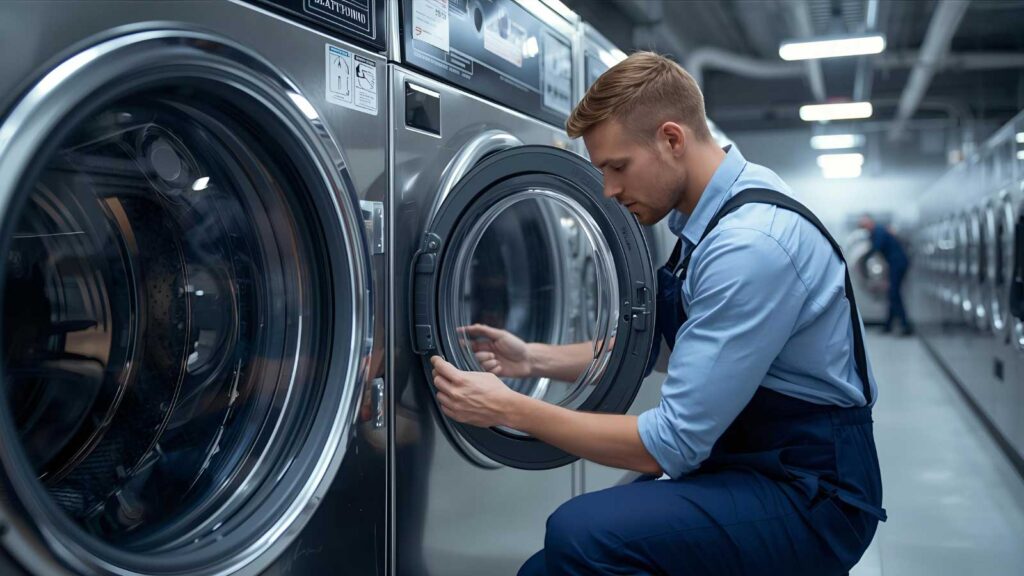
To protect your conservation investments, ongoing maintenance is vital. Over time, leaks and inefficiencies can add up, wasting the savings you gain from efficient commercial laundry equipment and processes.
Monthly Inspection Checklist for Hoses, Valves, and Seals
Even small leaks can add up quickly in busy facilities. A hose dripping once per second can waste more than 2,000 gallons a year, and multiple small issues can compound without anyone noticing.
To prevent water waste and ensure your equipment runs efficiently, conduct monthly inspections to catch issues early.
Here’s what to look for:
- Check hose connections: Look for moisture, corrosion, or mineral deposits that indicate slow leaks. Catching these early helps prevent wear on your commercial laundry equipment.
- Inspect door seals on front-load machines: Look for cracks, gaps, or debris. A clean, intact seal helps the machine wash effectively and keeps cycles running as intended.
- Test fill valves: Run an empty cycle and confirm the valve shuts off at the right time. This keeps cycles consistent and prevents unnecessary strain on internal components.
- Examine drain hoses: Check for kinks, blockages, or leaks at connection points. Obstructions in drain hoses can prevent proper water flow, forcing machines to use more water to complete the cycle or leading to water waste during drainage.
- Verify pressure regulators: Confirm that PSI levels stay within the recommended range. Regular checks help keep machines operating consistently and support long-term water efficiency.
Be sure to document inspections and address any issues immediately. Delaying maintenance can lead to higher repair costs down the line.
Staff Training on Detergent Dosing and Loading Techniques
Human actions play a big role in water usage. Incorrect detergent dosing leads to excess suds, which often results in the need for extra rinse cycles. Improper loading techniques can also cause rewashes, further wasting water.
Brief training sessions can help staff make smarter choices, such as:
- Proper detergent measurement based on load sizes and soil levels: Accurate dosing keeps cycles from running longer than needed and maintains consistent results.
- Training should help staff recognize when a load is too full or too light: Balanced loading improves cleaning quality and helps your commercial laundry machines run the way they’re designed to.
- Identifying early signs of mechanical issues: Staff who can spot unusual noises, vibrations, or leaks can help resolve problems before they interrupt workflow.
- Understanding how their daily choices affect operations: When staff know the impact of correct loading, dosing, and reporting issues, they can help keep the entire system running smoothly.
Related Article: How to Train Staff for Effective Laundry Room Operations
Getting Started with a Water Efficiency Assessment
Implementing effective water conservation in your commercial laundry facility requires the right expertise, equipment, and ongoing attention. ACE Laundry offers all of this through integrated solutions tailored for properties throughout Southern California.
Contact ACE Laundry today or explore our selection of commercial laundry equipment for sale online. We’ll help you reduce water costs while ensuring your tenants and guests continue to enjoy the clean results they expect. Let us take care of your laundry equipment needs so you can focus on running your business!
Next Read: Easy Ways to Save Money on Laundry