Selecting the right commercial washer and dryer capacity directly affects the efficiency of your operation, utility costs, and customer satisfaction. Properly sized equipment moves laundry through quickly, reduces waste, and minimizes delays. Choosing the wrong size, however, can create backups, drive up expenses, and frustrate staff and customers.
This guide breaks down capacity selection based on business type, available space, and daily demand. You’ll learn how to assess your workload, avoid sizing mistakes, and choose washers and dryers that support your business for years.
Why Capacity Selection Makes or Breaks Your Laundry Operation
Every washer and dryer impacts your workflow, utility usage, and customer experience. Choosing the right capacity ensures smooth operations and strong margins, while incorrect sizing leads to inefficiencies and higher costs.
The Real Cost of Choosing the Wrong Capacity
Undersized machines force constant cycling. For example, a 20-lb washer trying to keep up with 40 lbs per hour needs twice the cycles. This leads to:
- Doubled water and energy use
- Increased wear on machine parts
- Longer wait times for customers and more staff time managing backups
Dryers that can’t keep up create bottlenecks, with wet laundry piling up, cycle times stretching, fabrics wearing faster, and more customer complaints.
Oversized machines waste resources in the opposite direction. A 60-lb dryer running half-full burns the same utilities as a packed load, raising operating costs without generating extra revenue.
Avoid these issues by assessing your actual laundry volume and customer habits.
Planning for Current Volume and Future Growth
Start by calculating your current high-demand laundry volume in pounds. How many loads run during your busiest 2 to 3 hours? Multiply that number by the growth you expect over the next 3 to 5 years.
Modular capacity planning helps you stay flexible. Instead of buying one oversized machine, build a mix of different capacities. This lets you:
- Handle your current volume efficiently
- Add more units as demand grows
- Spread out major purchases
- Keep each machine at a high utilization rate
- Adjust your setup as customer patterns change
A balanced equipment layout supports steady growth without major remodels or expensive changes later.
Capacity Recommendations by Business Type
Each commercial laundry operation runs differently. Your needs won’t match the hotel down the street or the laundromat across town. When you understand how your business actually works day to day, you make smarter choices about the capacity you need.
1. Laundromats: Matching Machine Mix to Customer Diversity
If you run a laundromat, you see every type of load walk through the door. Some customers bring a small mid-week wash. Others show up with full family baskets. Then you have the people hauling in comforters, blankets, or anything too big for a home washer.
Your setup works best when you offer a range of capacities:
- Small-capacity washers (20-25 lbs): Great for everyday loads from individuals or couples. These cycles are fast and keep lines moving during rush hour.
- Medium-capacity units (30-40 lbs): Your workhorses. These fit most family loads and give you the best mix of speed and volume.
- Large or mega-capacity machines (60-80 lbs): These bring in customers with oversized items and let you charge premium pricing. Pair them with large commercial clothes dryers to keep everything moving.
Your neighborhood demographics shape the ideal mix. If your area has more families, you’ll want more medium and large units. If you’re near apartments, student housing, or single-occupancy rentals, extra small-capacity machines often serve you better.
2. Multi-Housing and Apartment Buildings
If you manage laundry rooms in apartments or condos, you’re dealing with bedding, towels, and steady family loads. Medium to large machines (30–50 lbs) usually give residents the best experience.
Your choices depend on a few factors:
- How many residents you serve: More people mean you need a higher total throughput.
- Unit sizes: Larger apartments with families need a bigger capacity for bedding and bulkier loads.
- Usage patterns: Properties filled with working professionals often get heavy evening and weekend traffic.
A 50-unit building with mostly one-bedroom units may work well with smaller machines and more total units. A family-focused community benefits from commercial washers and dryers that handle bedding without forcing multiple cycles.
3. Hotels, Salons, and Specialty Operations
If you run an on-premise laundry (OPL), your volume stays steady and predictable. Hotels wash sheets and towels nonstop. Salons and spas run smaller, frequent batches. Gyms cycle through towels all day.
For hotels, large-capacity washers (50-80 lbs) paired with matching commercial dryers keep bulky linens moving fast. One 80-lb washer can do the work of several small machines, which cuts time and labor.
For salons, spas, and fitness centers, smaller machines running multiple short cycles often fit your workflow better. Oversized equipment often sits idle between batches, wasting space.
Match your equipment capacity to your laundry type and your daily schedule. If you process high-volume loads around the clock, larger machines pay off. If your laundry comes in waves or small batches, a flexible set of smaller units gives you more control.
Also Read: How to Choose the Right Laundry Equipment for Your Industry
Space and Configuration Considerations
Your available floor space limits what you can install. Older, tighter laundry rooms offer fewer options than large, open laundromats, which affects machine selection and layout.
Stacked Units vs. Side-by-Side Configurations
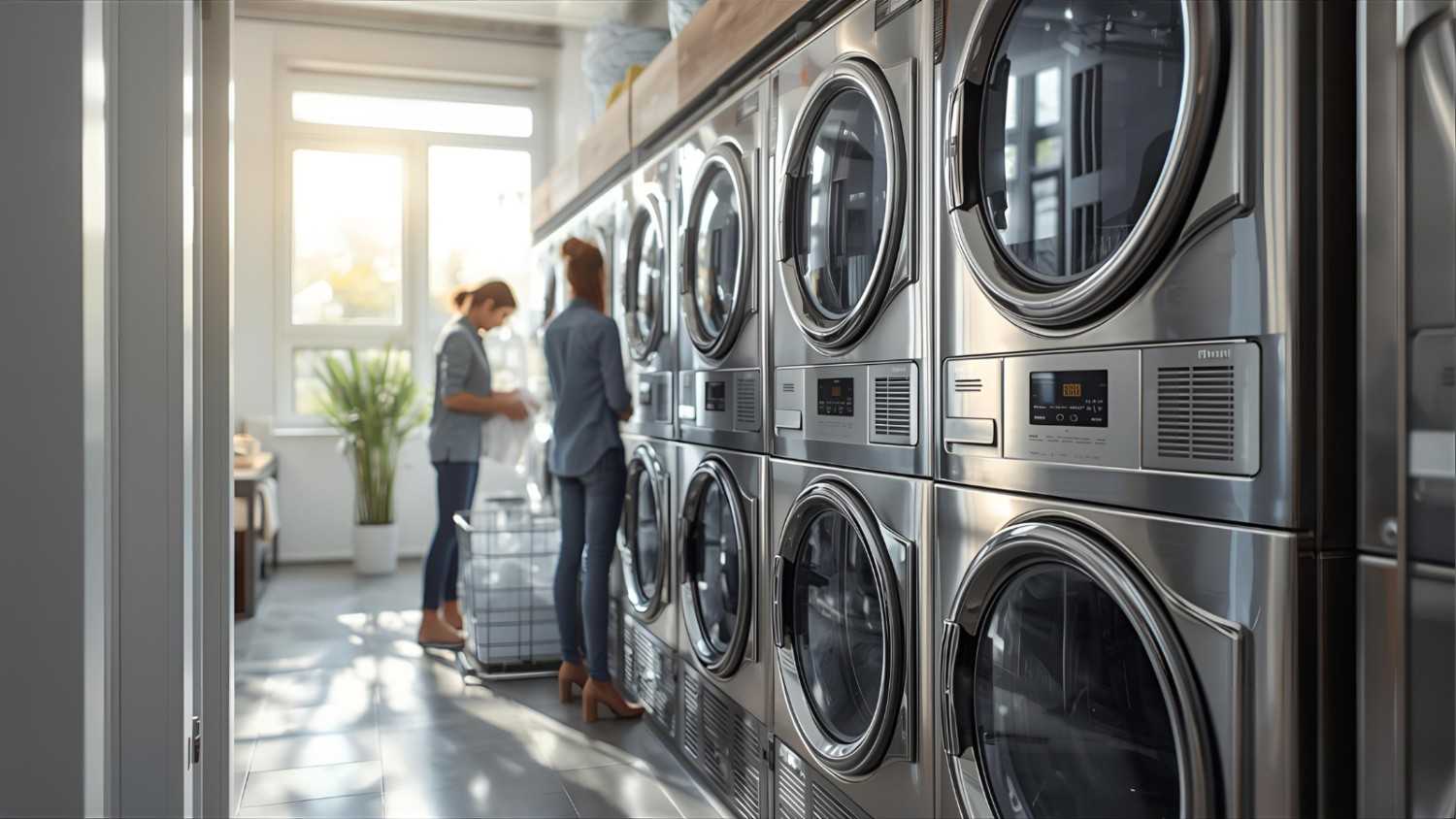
Stacked washer-dryer setups help you save space when every inch counts. If you manage a multi-housing laundry room with a small footprint, stacking lets you fit more units without expanding the room. You build upward instead of outward.
The trade-off is capacity. Stacked units usually top out around 30-35 lbs, so you give up some throughput to gain space.
Side-by-side equipment works better when you have room to spread out. Laundromats and OPL facilities often rely on large standalone machines because they offer higher capacity and easier access for maintenance. A row of 60-lb washers feeding into matching commercial dryers moves far more laundry per hour than the same floor area filled with stacked units.
Huebsch Galaxy and Quantum models offer a range of 20-80+ lb capacities in side-by-side formats. Reviewing the specs helps you compare what fits your space and your workflow.
Ventilation and Maintenance Access Requirements
Your dryers need proper ventilation and enough clearance for exhaust, gas lines, and service access. This affects which capacities you can safely install. Before you lock in your equipment choices, confirm that your space meets all code requirements.
Here are the key things you need to check:
- Exhaust path: Shorter, straighter runs improve dryer performance and reduce lint buildup.
- Gas line access: You need clear space for valves and safe connections.
- Electrical capacity: Larger machines require the right circuits.
- Service clearance: Technicians need room to reach components during repairs.
- Door swing space: Front-loaders need space for customers to load and unload easily.
Consult with your equipment provider and local code officials before committing to specific machine sizes. A commercial dryer that physically fits but fails ventilation or clearance requirements turns into an expensive problem later.
How to Calculate the Right Capacity for Your Operation
Capacity planning gets much easier once you know your actual laundry volume. The goal isn’t to size your machines for an “average” day. You want equipment that keeps up with your busiest hours. When your machines can handle rush periods, everything runs smoothly during slower times.
Estimating Weekly Laundry Volume
Start by tracking how much laundry you move through in a typical week. For laundromats, monitor machine usage during busy hours (typically weekend mornings and weekday evenings). For OPL operations, weigh your soiled linen carts before you start processing.
Here’s the information you want to collect:
- Pounds of laundry you process during your busiest 3-hour window
- Average load weight for clothing, bedding, and towels
- Current machine wait times during peak times
- Machines sitting idle during slow hours
- Any customer complaints about availability or long cycle times
Once you gather this data, you get a clear picture of what your operation truly needs.
Matching Volume to Machine Specs
Commercial washers and dryers are rated by their maximum load size. A 40-lb washer, for example, holds up to 40 lbs of dry laundry each cycle. Most wash cycles take 25-35 minutes, and dryer cycles usually take 30-45 minutes.
Use this simple approach to figure out the capacity you need:
- Measure the pounds you process during your busiest window
- Divide that number by the hours in that window to get pounds per hour
- Divide by machine capacity to estimate how many units you need
Example: If you move 400 lbs of laundry through your operation during a three-hour rush, you’re processing about 133 lbs per hour. Three 40-lb washers running continuously will cover that. Two 60-lb units give you extra breathing room for unexpected spikes.
Pair your washers with dryers that keep up. Since dryer cycles run slightly longer, you often need equal or slightly higher drying capacity to avoid wet laundry piling up.
If you’re running a commercial washer-and-dryer coin-operated setup, build in a little extra room. Customers leave loads sitting, run partial loads, or need more time to switch machines. Adding 15–20% more capacity than your minimum calculation helps you keep things moving when real-world behavior doesn’t match the math.
Get the Right Support for Your Capacity Planning
You don’t have to figure everything out on your own. At ACE Laundry, we’ve supported laundry businesses, property managers, and OPL teams across Southern California for decades. When you work with our team, you get guidance that helps you understand your space, your volume, and how your operation runs so you can choose the right equipment with confidence.
We take the time to understand your needs, so you choose washers, dryers, and complete laundry systems that fit your operation. You won’t get generic suggestions or pressure to buy equipment you don’t need.
Contact us now to request a capacity assessment or browse our laundry solutions to start planning! Our specialists will walk you through the process and help you choose machines that work for you now and support your growth later.